CarteduCiel.eu
FR

The Hyades

Open cluster

≈ 153 light-years away, in the constellation Taurus. Naked eye, under a dark sky.
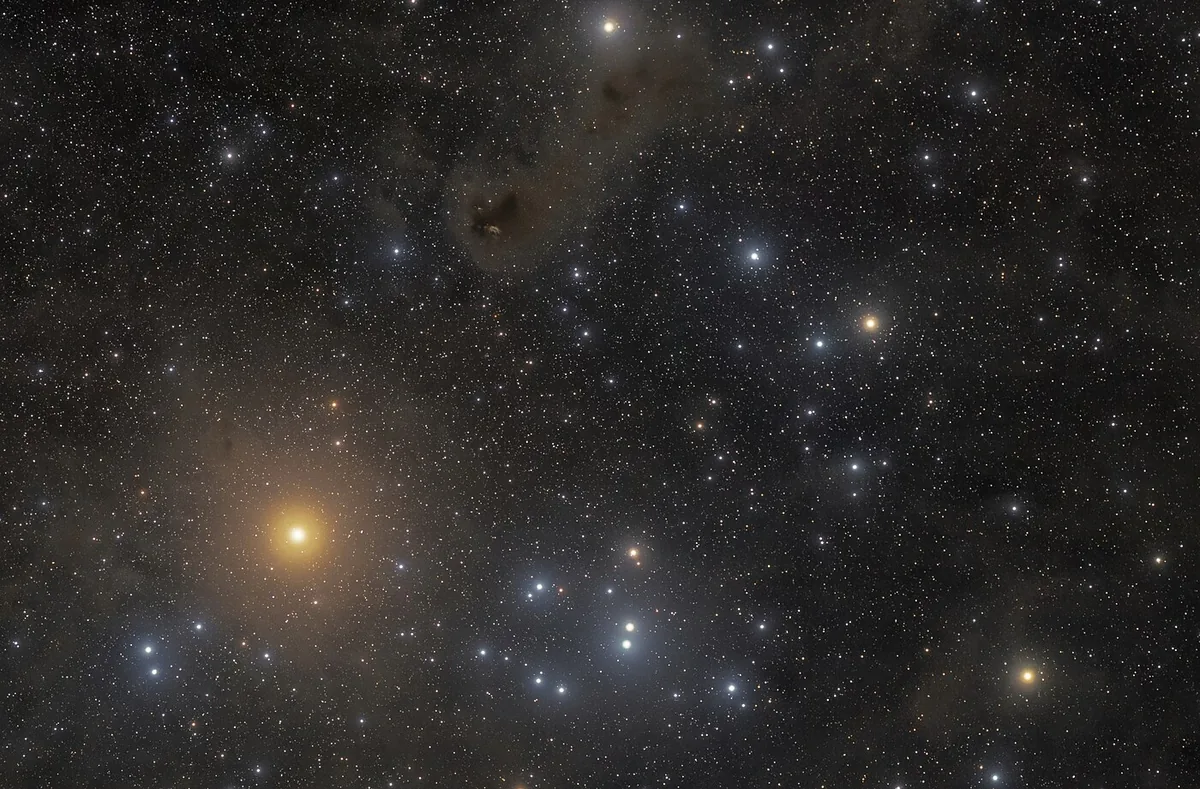
TaurusMelotte 25Collinder 50
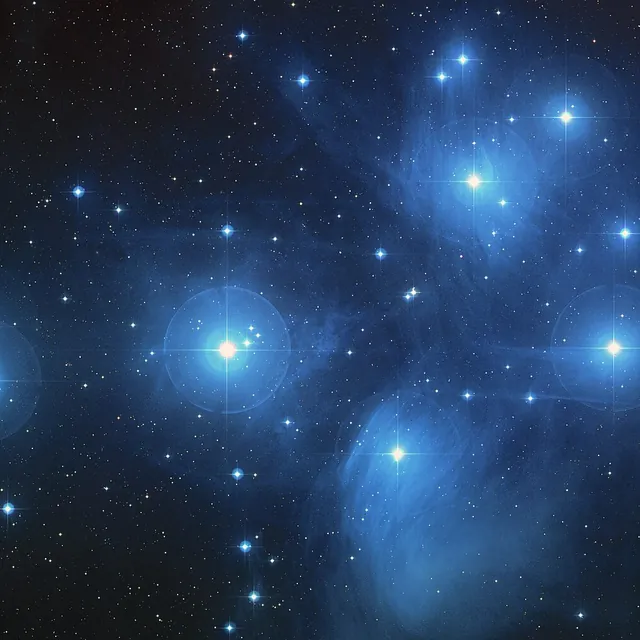
Photograph: The Hyades
Photo: Giuseppe Donatiello · licence CC0 · Wikimedia Commons · cropped and resized

1Overview

The Hyades form the V that draws the head of Taurus, next to the star Aldebaran. It is the nearest star cluster to the Sun, about 153 light-years away, and one of the easiest to see: several of its stars shine to the naked eye, and binoculars show dozens.

Aldebaran, which seems to belong to it, is actually twice as close. The Hyades are about 625 million years old; they move in the same direction as the Beehive in Cancer, probably their sister. Because it is close, the cluster served as the first rung for measuring distances in the Universe. For the Greeks the Hyades were the weeping sisters of Hyas, and their rising heralded the rains.

2How to find it

C041Celaeno, 16 Tau · magnitude 5.45Pleione, 28 Tau · magnitude 5.05136 Tau · magnitude 4.5671 Tau · magnitude 4.4837 Tau · magnitude 4.36119 Tau · magnitude 4.32δ³ Tau · magnitude 4.30Taygeta, 19 Tau · magnitude 4.3010 Tau · magnitude 4.29υ Tau · magnitude 4.28τ Tau · magnitude 4.2790 Tau · magnitude 4.27μ Tau · magnitude 4.2788 Tau · magnitude 4.25κ¹ Tau · magnitude 4.21Merope, 23 Tau · magnitude 4.145 Tau · magnitude 4.14ν Tau · magnitude 3.91Maia, 20 Tau · magnitude 3.87θ¹ Tau · magnitude 3.84Secunda Hyadum, δ¹ Tau · magnitude 3.77ξ Tau · magnitude 3.73Electra, 17 Tau · magnitude 3.72Prima Hyadum, γ Tau · magnitude 3.65Atlas, 27 Tau · magnitude 3.62ο Tau · magnitude 3.61Ain, ε Tau · magnitude 3.53λ Tau · magnitude 3.41Chamukuy, θ² Tau · magnitude 3.40Tianguan, ζ Tau · magnitude 2.97Alcyone, η Tau · magnitude 2.85Elnath, β Tau · magnitude 1.65Aldebaran, α Tau · magnitude 0.87C041AldebaranElnathηζθ²λεοξνκ¹τμδ³ORIONNWES

Finder chart drawn by CarteDuCiel.eu: the object is circled in orange. North up, east left.

Where to see it tonight?
Working it out…

3When to observe it

From mid-northern latitudes (46° N), the best time to observe it is in the evening in December, when it culminates 60° above the horizon. Choose a moonless night, away from lights.
0°30°60°90°JanFebMarAprMayJunJulAugSepOctNovDecMid-northern (46° N) · January : 56°Mid-northern (46° N) · February : 39°Mid-northern (46° N) · March : 21°Mid-northern (46° N) · April : 0°Mid-northern (46° N) · May : -17°Mid-northern (46° N) · June : -27°Mid-northern (46° N) · July : -26°Mid-northern (46° N) · August : -15°Mid-northern (46° N) · September : 3°Mid-northern (46° N) · October : 23°Mid-northern (46° N) · November : 44°Mid-northern (46° N) · December : 58°Mid-southern (34° S) · January : 37°Mid-southern (34° S) · February : 22°Mid-southern (34° S) · March : 2°Mid-southern (34° S) · April : -23°Mid-southern (34° S) · May : -47°Mid-southern (34° S) · June : -69°Mid-southern (34° S) · July : -66°Mid-southern (34° S) · August : -44°Mid-southern (34° S) · September : -19°Mid-southern (34° S) · October : 5°Mid-southern (34° S) · November : 26°Mid-southern (34° S) · December : 39°Mid-northern (46° N)Mid-southern (34° S)horizon

4Also worth seeing