CarteduCiel.eu
FR

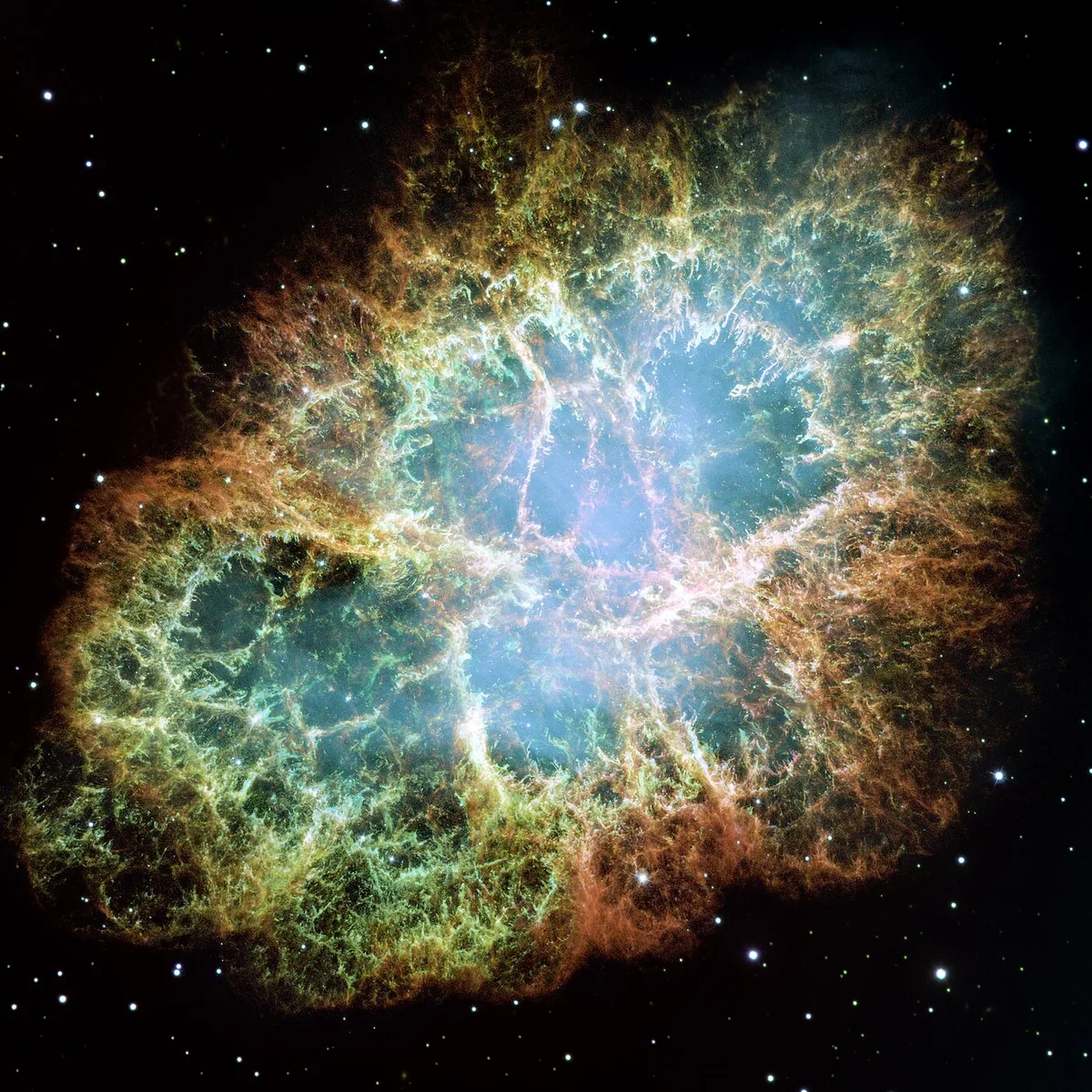
The Crab Nebula

Supernova remnant

≈ 6,500 light-years away, in the constellation Taurus. With a telescope.
TaurusM1NGC 1952
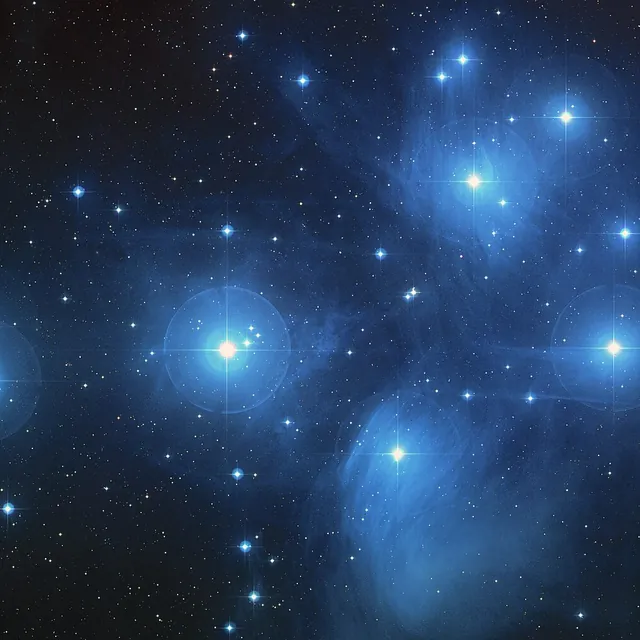
Photograph: The Crab Nebula
Photo: NASA, ESA, J. Hester and A. Loll (Arizona State University) · public domain · Wikimedia Commons · cropped and resized

1Overview

The Crab Nebula (M1), in Taurus, is the cloud left by the explosion of a star seen by Chinese astronomers in 1054. This “guest star” remained visible in daylight for 23 days and at night for nearly two years.

Today the cloud is about ten light-years across and is still expanding at more than 1,000 km/s. At its centre spins the star’s corpse: a pulsar, a neutron star 20 km wide that turns 30 times a second and sweeps space with its beams like a lighthouse. It is this pulsar that makes the whole nebula shine.

In 1758 Charles Messier mistook it for a comet; to avoid further confusion he began the list of fuzzy objects that would become his famous catalogue, in which the Crab is number 1.

2How to find it

M1Celaeno, 16 Tau · magnitude 5.45Pleione, 28 Tau · magnitude 5.05136 Tau · magnitude 4.5671 Tau · magnitude 4.4837 Tau · magnitude 4.36119 Tau · magnitude 4.32δ³ Tau · magnitude 4.30Taygeta, 19 Tau · magnitude 4.3010 Tau · magnitude 4.29υ Tau · magnitude 4.28τ Tau · magnitude 4.2790 Tau · magnitude 4.27μ Tau · magnitude 4.2788 Tau · magnitude 4.25κ¹ Tau · magnitude 4.21Merope, 23 Tau · magnitude 4.145 Tau · magnitude 4.14ν Tau · magnitude 3.91Maia, 20 Tau · magnitude 3.87θ¹ Tau · magnitude 3.84Secunda Hyadum, δ¹ Tau · magnitude 3.77ξ Tau · magnitude 3.73Electra, 17 Tau · magnitude 3.72Prima Hyadum, γ Tau · magnitude 3.65Atlas, 27 Tau · magnitude 3.62ο Tau · magnitude 3.61Ain, ε Tau · magnitude 3.53λ Tau · magnitude 3.41Chamukuy, θ² Tau · magnitude 3.40Tianguan, ζ Tau · magnitude 2.97Alcyone, η Tau · magnitude 2.85Elnath, β Tau · magnitude 1.65Aldebaran, α Tau · magnitude 0.87M1AldebaranElnathηζθ²λεογξνκ¹τμδ³ORIONNWES

Finder chart drawn by CarteDuCiel.eu: the object is circled in orange. North up, east left.

Where to see it tonight?
Working it out…

3When to observe it

From mid-northern latitudes (46° N), the best time to observe it is in the evening in January, when it culminates 66° above the horizon. Choose a moonless night, away from lights.
0°30°60°90°JanFebMarAprMayJunJulAugSepOctNovDecMid-northern (46° N) · January : 66°Mid-northern (46° N) · February : 55°Mid-northern (46° N) · March : 37°Mid-northern (46° N) · April : 16°Mid-northern (46° N) · May : -3°Mid-northern (46° N) · June : -17°Mid-northern (46° N) · July : -22°Mid-northern (46° N) · August : -17°Mid-northern (46° N) · September : -2°Mid-northern (46° N) · October : 16°Mid-northern (46° N) · November : 37°Mid-northern (46° N) · December : 56°Mid-southern (34° S) · January : 34°Mid-southern (34° S) · February : 26°Mid-southern (34° S) · March : 10°Mid-southern (34° S) · April : -12°Mid-southern (34° S) · May : -36°Mid-southern (34° S) · June : -61°Mid-southern (34° S) · July : -78°Mid-southern (34° S) · August : -61°Mid-southern (34° S) · September : -36°Mid-southern (34° S) · October : -12°Mid-southern (34° S) · November : 11°Mid-southern (34° S) · December : 27°Mid-northern (46° N)Mid-southern (34° S)horizon

4Also worth seeing