The Veil Nebula
Supernova remnant
≈ 2,400 light-years away, in the constellation Cygnus. With a telescope.
1Overview
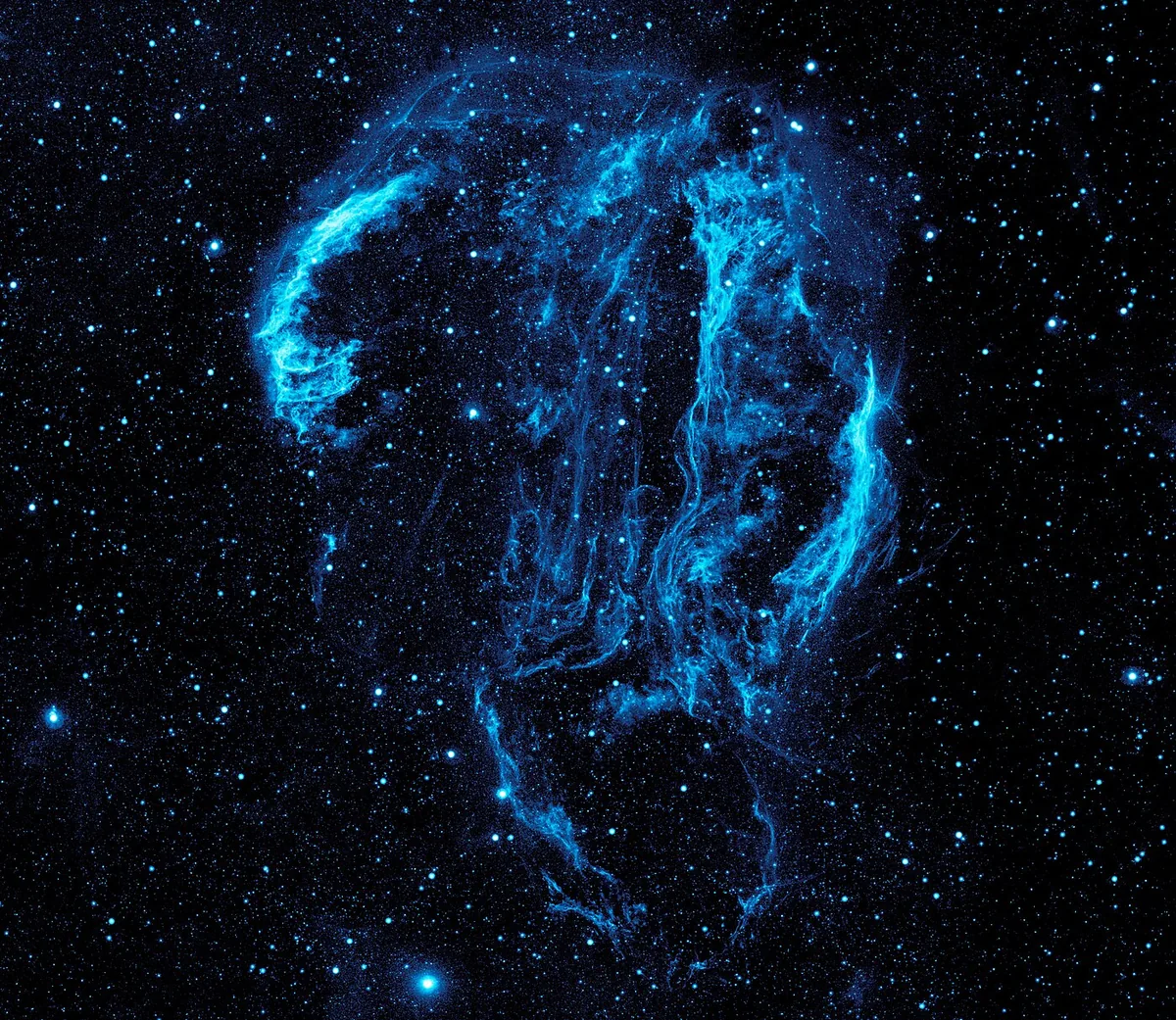
The Veil Nebula (or Cygnus Loop) is the remains of a star that exploded 10,000 to 20,000 years ago, about 2,400 light-years away. The ejected gas now forms a huge bubble of filaments, six times as wide as the full Moon, south of the eastern wing of Cygnus.
Its brightest arcs, NGC 6960 (which passes in front of the star 52 Cygni) and NGC 6992, were discovered by William Herschel in 1784. They are hard to see without a special filter, but in photographs their red and blue filaments look like delicate lace.
2How to find it
Finder chart drawn by CarteDuCiel.eu: the object is circled in orange. North up, east left.
Working it out…
3When to observe it
From mid-northern latitudes (46° N), the best time to observe it is in the evening in September, when it culminates 75° above the horizon. Choose a moonless night, away from lights.
 The Crab Nebula
 The Andromeda Galaxy
 The Orion Nebula
 The Pleiades