Lupus
Wolf
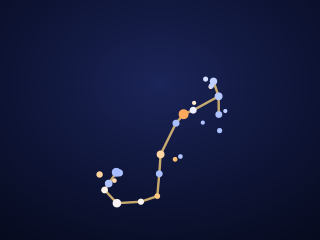
Lupus (Wolf), a wolf. A constellation of the southern sky; in the evening it is at its best in June. Its brightest star is α Lupi.
Working out its position…
1How to find it
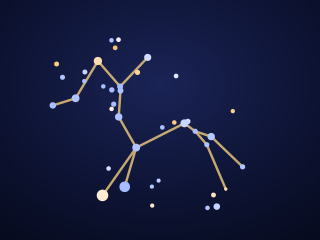
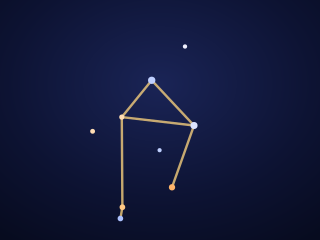
Lupus lies in the southern sky between Centaurus and Scorpius, on the edge of the Milky Way. Its stars of magnitude 2 to 4 form an irregular shape just south of Libra. From southern Europe its northern part appears very low on the horizon on June evenings; you see all of it south of about latitude 35° N.
2The main stars
| Star | Name | Magnitude | Distance | Type |
|---|---|---|---|---|
| α Lupi | — | 2.30 | 465 ly | B1.5III · blue-white giant |
| β Lupi | — | 2.68 | 383 ly | B2III · blue-white giant |
| γ Lupi | — | 2.80 | 421 ly | B2IV · blue-white subgiant |
| δ Lupi | — | 3.22 | 884 ly | B1.5IV · blue-white subgiant |
| ε Lupi | — | 3.37 | 512 ly | B2IV · blue-white subgiant |
| ζ Lupi | — | 3.41 | 117 ly | G8III · yellow giant |
| η Lupi | — | 3.42 | 442 ly | B2.5IV · blue-white subgiant |
| ι Lupi | — | 3.55 | 338 ly | B2.5IV · blue-white subgiant |
| φ¹ Lupi | — | 3.57 | 275 ly | K5III · orange giant |
| κ¹ Lupi | — | 3.88 | 180 ly | B9V · blue-white, main sequence |
The smaller the magnitude, the brighter the star. Distances come from the Hipparcos satellite; beyond a few hundred light-years they are approximate.
3Myth and origin of the name
For the Greeks this figure was not a wolf but simply “the Beast”, a wild animal that the Centaur holds on the end of a pole, like an offering carried to the nearby Altar. It was the Romans who called it Lupus, the wolf.
It has sometimes been linked to Lycaon, a king of Arcadia who dared to serve human flesh to Zeus to test whether he was truly a god. Furious, Zeus turned him into a wolf.
4History
It is one of the 48 constellations described by Claudius Ptolemy around AD 150 in the Almagest, the great treatise of Greek astronomy that remained the reference for more than a thousand years.
In the spring of 1006 a new star blazed in Lupus and became the brightest ever reported by chroniclers: the Egyptian astronomer Ali ibn Ridwan described it as two to three times larger than Venus, and it was recorded in China, Japan, Europe and the Arab world. We now know it was a supernova, SN 1006, which has left an expanding cloud behind.
Its present boundaries were drawn by the Belgian astronomer Eugène Delporte and adopted by the International Astronomical Union in 1930, like those of the other 87 constellations.
5Notable objects
6When to observe it
It is fully visible from every latitude south of 34° N. From mid-northern latitudes such as France (46° N), only its northern part rises above the southern horizon; to see all of it you need to be south of latitude 34° N. In the evening around 10 pm, it is highest in the sky in June (seen from mid-northern latitudes).
 Centaurus
 Circinus
 Libra
 Norma
 Scorpius