Norma
Carpenter’s Square
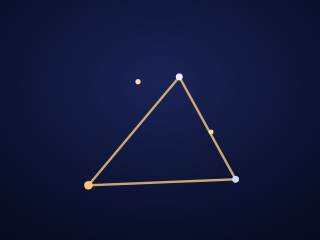
Norma (Carpenter’s Square), a set square. A constellation of the southern sky; in the evening it is at its best in June. Its brightest star is γ² Normae.
Working out its position…
1How to find it
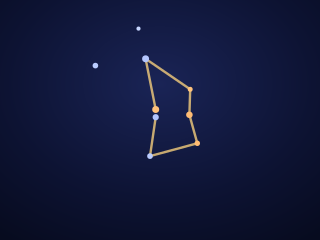
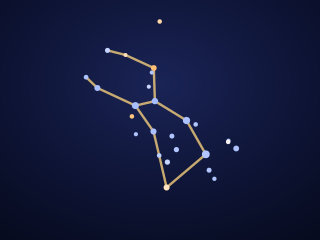
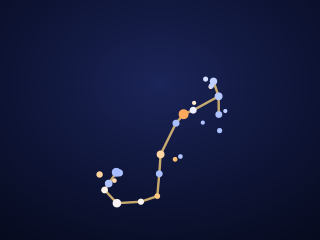
Norma is a small southern constellation with no bright stars, nestled in the Milky Way between Lupus, Scorpius and Ara. Its few magnitude 4 stars form a small triangle. From the southern hemisphere, look for it just west of the tail of Scorpius. It is practically invisible from mid-northern latitudes.
2The main stars
| Star | Name | Magnitude | Distance | Type |
|---|---|---|---|---|
| γ² Normae | — | 4.01 | 129 ly | G8III · yellow giant |
| ε Normae | — | 4.46 | 530 ly | B4V · blue-white, main sequence |
| ι¹ Normae | — | 4.63 | 128 ly | A7IV · white subgiant |
| η Normae | — | 4.65 | 220 ly | G8III · yellow giant |
| δ Normae | — | 4.73 | 122 ly | A · white |
| μ Normae | — | 4.86 | — | B0Ia · blue-white supergiant |
| κ Normae | — | 4.95 | 428 ly | G4III · yellow giant |
| γ¹ Normae | — | 4.97 | 1,469 ly | F9Ia · yellow-white supergiant |
| θ Normae | — | 5.13 | 386 ly | B8V · blue-white, main sequence |
| HR 6083 | — | 5.32 | 463 ly | B6IV · blue-white subgiant |
The smaller the magnitude, the brighter the star. Distances come from the Hipparcos satellite; beyond a few hundred light-years they are approximate.
3Myth and origin of the name
Lacaille named it “the Set Square and Ruler”, two tools of the surveyor and the architect, placed near Circinus and Triangulum Australe. No legend, then, but a tribute to the instruments used to draw right angles and perfect lines.
To create it, Lacaille borrowed stars from its neighbours, so that Norma lost its Alpha and Beta stars in later reshuffles: they were given back to Scorpius. Its brightest star is now called Gamma.
4History
The French astronomer Nicolas-Louis de Lacaille created it after charting nearly 10,000 southern stars from the Cape of Good Hope in 1751 and 1752. Like his thirteen other constellations, it honours an instrument of the sciences or the arts; it appears on his planisphere of 1756.
Behind the Milky Way in Norma lies the Norma galaxy cluster, a huge concentration of matter near the “Great Attractor”, a region towards which our galaxy and its neighbours are being pulled.
Its present boundaries were drawn by the Belgian astronomer Eugène Delporte and adopted by the International Astronomical Union in 1930, like those of the other 87 constellations.
5Notable objects
6When to observe it
It is fully visible from every latitude south of 30° N. From mid-northern latitudes such as France (46° N), only its northern part rises above the southern horizon; to see all of it you need to be south of latitude 30° N. In the evening around 10 pm, it is highest in the sky in June (seen from mid-northern latitudes).
 Ara
 Circinus
 Lupus
 Scorpius
 Triangulum Australe