Crater
Cup
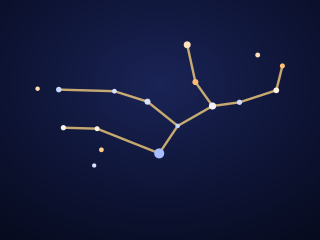
Crater (Cup), a cup. A constellation of the southern sky; in the evening it is at its best in April. Its brightest star is δ Crateris.
Working out its position…
1How to find it
Crater is a faint constellation sitting on Hydra’s back, just west of Corvus. Its stars of magnitude 3.5 to 4.5 outline a goblet or chalice, visible under a dark sky on April and May evenings, in the south. Start from Corvus, which is easy to see, then slide about fifteen degrees west.
2The main stars
| Star | Name | Magnitude | Distance | Type |
|---|---|---|---|---|
| δ Crateris | — | 3.56 | 186 ly | K0III · orange giant |
| γ Crateris | — | 4.06 | 82 ly | A9V · white, main sequence |
| α Crateris | Alkes | 4.08 | 159 ly | K1III · orange giant |
| β Crateris | — | 4.46 | 340 ly | A1V · white, main sequence |
| θ Crateris | — | 4.70 | 280 ly | B9.5V · blue-white, main sequence |
| ζ Crateris | — | 4.71 | 353 ly | G8III · yellow giant |
| ε Crateris | — | 4.81 | 376 ly | K5III · orange giant |
| λ Crateris | — | 5.08 | 140 ly | F3IV · yellow-white subgiant |
| η Crateris | — | 5.17 | 252 ly | A0V · white, main sequence |
| ι Crateris | — | 5.48 | 87 ly | F7V · yellow-white, main sequence |
The smaller the magnitude, the brighter the star. Distances come from the Hipparcos satellite; beyond a few hundred light-years they are approximate.
3Myth and origin of the name
Crater is the vessel Apollo gave his crow to fetch water. It has stayed out of reach of the punished bird, set on the body of the snake that guards it.
Other tales see the cup of Dionysus, god of wine, or that of a king who was punished by the gods after a cruel feast. Whatever the story, it is always a drinking vessel, beside the celestial water evoked by Hydra.
4History
It is one of the 48 constellations described by Claudius Ptolemy around AD 150 in the Almagest, the great treatise of Greek astronomy that remained the reference for more than a thousand years.
Its brightest star, Delta, only reaches magnitude 3.6. Crater has no easy objects, but it contains thousands of distant galaxies visible with large telescopes.
Its present boundaries were drawn by the Belgian astronomer Eugène Delporte and adopted by the International Astronomical Union in 1930, like those of the other 87 constellations.
5Notable objects
No deep-sky object here is easy to see with small instruments: this is a region to explore with a telescope and a detailed chart.
6When to observe it
It is fully visible from every latitude south of 65° N. In the evening around 10 pm, it is highest in the sky in April (seen from mid-northern latitudes).
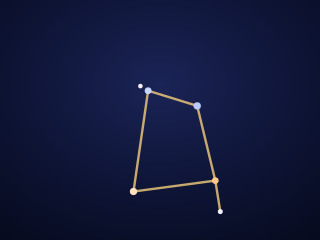 Corvus
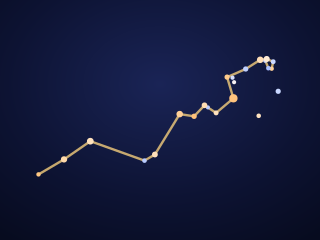 Hydra
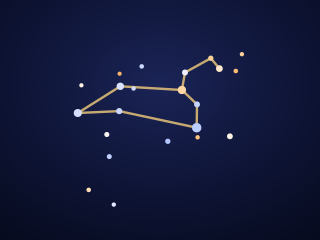 Leo
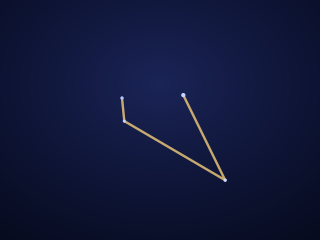 Sextans
 Virgo