Sextans
Sextant
Sextans (Sextant), an astronomer’s sextant. A constellation near the celestial equator, visible from both hemispheres; in the evening it is at its best in March. Its brightest star is α Sextantis.
Working out its position…
1How to find it
Sextans is a very faint constellation south of Leo, just below Regulus and above Hydra. None of its stars is brighter than magnitude 4.5; you need a truly dark sky. Start from Regulus and drop about a dozen degrees south: a small triangle of faint stars marks Sextans.
2The main stars
| Star | Name | Magnitude | Distance | Type |
|---|---|---|---|---|
| α Sextantis | — | 4.48 | 283 ly | A0III · white giant |
| γ Sextantis | — | 5.07 | 278 ly | A2V · white, main sequence |
| β Sextantis | — | 5.08 | 405 ly | B6V · blue-white, main sequence |
| δ Sextantis | — | 5.19 | 322 ly | B9.5V · blue-white, main sequence |
| ε Sextantis | — | 5.25 | 193 ly | F2III · yellow-white giant |
| HR 4092 | — | 5.60 | 397 ly | M0.5III · red giant |
| 18 Sextantis | — | 5.64 | 473 ly | K2III · orange giant |
| HR 3879 | — | 5.65 | 263 ly | F4IV · yellow-white subgiant |
| 19 Sextantis | — | 5.77 | 416 ly | K0III · orange giant |
| 35 Sextantis | — | 5.77 | 553 ly | K3III · orange giant |
The smaller the magnitude, the brighter the star. Distances come from the Hipparcos satellite; beyond a few hundred light-years they are approximate.
3Myth and origin of the name
Sextans is Johannes Hevelius’s favourite instrument: a large graduated arc, a sixth of a circle, with which he measured the distances between stars with the naked eye. In 1679 a fire swept through his house and observatory in Danzig, destroying his instruments, books and notes.
By placing a sextant in the sky between Leo and Hydra, Hevelius wanted to give the lost tool eternal life: up there, no fire could ever destroy it again.
4History
The Danzig astronomer Johannes Hevelius created it to fill a gap between older constellations. It appears in his atlas Firmamentum Sobiescianum, published in 1690, three years after his death.
Sextans contains the Spindle Galaxy (NGC 3115), a lenticular galaxy seen edge-on, and the Sextans Dwarf Galaxy, a satellite of the Milky Way discovered in 1990.
Its present boundaries were drawn by the Belgian astronomer Eugène Delporte and adopted by the International Astronomical Union in 1930, like those of the other 87 constellations.
5Notable objects
6When to observe it
It is fully visible between latitudes 78° N and 84° S. In the evening around 10 pm, it is highest in the sky in March (seen from mid-northern latitudes).
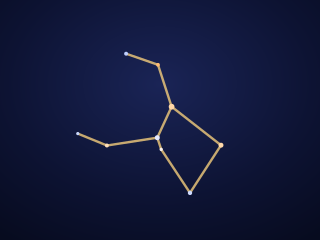 Crater
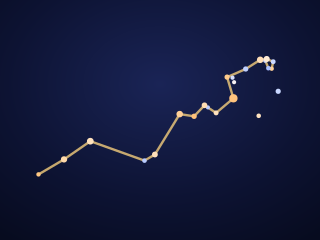 Hydra
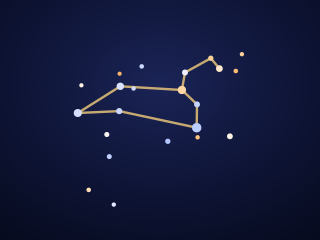 Leo