Serpens
Serpent
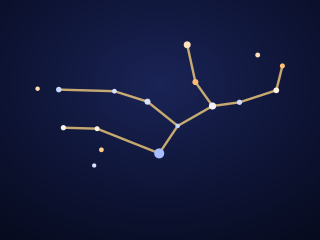
Serpens (Serpent), a snake. A constellation near the celestial equator, visible from both hemispheres; in the evening it is at its best in July. Its brightest star is Unukalhai.
Working out its position…
1How to find it
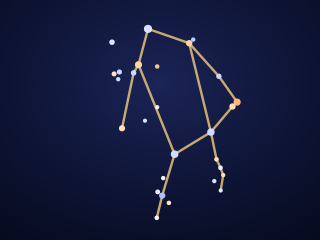
Serpens is the only constellation split in two: the Head (Serpens Caput) to the west and the Tail (Serpens Cauda) to the east, separated by Ophiuchus, who holds the animal in both hands. The Head, the more visible part, is a small triangle of stars just south of Corona Borealis, followed by a line running down to Unukalhai, the brightest star. The Tail runs towards Aquila, in the Milky Way. Both are seen on summer evenings.
2The main stars
| Star | Name | Magnitude | Distance | Type |
|---|---|---|---|---|
| α Serpentis | Unukalhai | 2.63 | 74 ly | K2III · orange giant |
| η Serpentis | — | 3.23 | 60 ly | K0III · orange giant |
| μ Serpentis | — | 3.54 | 170 ly | A0V · white, main sequence |
| ξ Serpentis | — | 3.54 | 105 ly | F0III · yellow-white giant |
| β Serpentis | — | 3.65 | 155 ly | A3V · white, main sequence |
| ε Serpentis | — | 3.71 | 70 ly | A2 · white |
| δ Serpentis | — | 3.80 | 228 ly | F0IV · yellow-white subgiant |
| γ Serpentis | — | 3.85 | 37 ly | F6V · yellow-white, main sequence |
| κ Serpentis | Gudja | 4.09 | 382 ly | M1III · red giant |
| ο Serpentis | — | 4.24 | 173 ly | A2V · white, main sequence |
The smaller the magnitude, the brighter the star. Distances come from the Hipparcos satellite; beyond a few hundred light-years they are approximate.
3Myth and origin of the name
Serpens is the animal held by Asclepius, the god of medicine shown as Ophiuchus. The snake, which sheds its skin and seems to be reborn, was for the Greeks a symbol of healing and renewal; snakes were kept in the sanctuaries of Asclepius.
In the sky Ophiuchus grips the snake around the middle, and the two halves spill out on either side of his body. That is why the International Astronomical Union kept a single constellation of Serpens, but in two pieces.
4History
It is one of the 48 constellations described by Claudius Ptolemy around AD 150 in the Almagest, the great treatise of Greek astronomy that remained the reference for more than a thousand years.
The Tail of Serpens contains the Eagle Nebula (M16) and its “Pillars of Creation”, tall columns of gas photographed in 1995 by the Hubble Space Telescope. The Head holds the fine globular cluster M5 and Hoag’s Object, an astonishing ring-shaped galaxy discovered in 1950.
Its present boundaries were drawn by the Belgian astronomer Eugène Delporte and adopted by the International Astronomical Union in 1930, like those of the other 87 constellations.
5Notable objects
6When to observe it
It is fully visible between latitudes 74° N and 64° S. In the evening around 10 pm, it is highest in the sky in July (seen from mid-northern latitudes).
 Aquila
 Boötes
 Corona Borealis
 Hercules
 Libra
 Ophiuchus
 Scutum
 Sagittarius
 Virgo