Ophiuchus
Serpent Bearer
Ophiuchus (Serpent Bearer), a man holding a snake. A constellation near the celestial equator, visible from both hemispheres; in the evening it is at its best in July. Its brightest star is Rasalhague.
Working out its position…
1How to find it
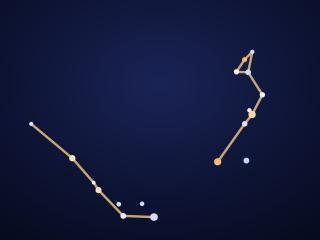
Ophiuchus, the Serpent Bearer, is a very large summer constellation shaped like a house or a coffin, set above Scorpius and below Hercules. Its head, Rasalhague, is the bright star (magnitude 2.1) close to the head of Hercules, west of Vega and Altair. From there the body widens southwards to the neighbourhood of Antares. Serpens, split in two, passes through his hands on either side.
2The main stars
| Star | Name | Magnitude | Distance | Type |
|---|---|---|---|---|
| α Ophiuchi | Rasalhague | 2.08 | 49 ly | A5III · white giant |
| η Ophiuchi | Sabik | 2.43 | 88 ly | A2.5V · white, main sequence |
| ζ Ophiuchi | — | 2.54 | 366 ly | O9.5V · blue, main sequence |
| δ Ophiuchi | Yed Prior | 2.73 | 171 ly | M1III · red giant |
| β Ophiuchi | Cebalrai | 2.76 | 82 ly | K2III · orange giant |
| κ Ophiuchi | — | 3.19 | 92 ly | K2III · orange giant |
| ε Ophiuchi | Yed Posterior | 3.23 | 106 ly | G8III · yellow giant |
| θ Ophiuchi | — | 3.27 | 436 ly | B2IV · blue-white subgiant |
| ν Ophiuchi | — | 3.32 | 151 ly | K0III · orange giant |
| HIP 0 | — | 3.40 | 84 ly | A3V · white, main sequence |
The smaller the magnitude, the brighter the star. Distances come from the Hipparcos satellite; beyond a few hundred light-years they are approximate.
3Myth and origin of the name
Ophiuchus is Asclepius, son of Apollo, raised by the centaur Chiron, who taught him medicine. He became such a gifted healer that he even managed to bring the dead back to life. Hades, ruler of the underworld, complained that his kingdom was emptying, and Zeus struck Asclepius with a thunderbolt to preserve the order of the world. He then set him among the stars to honour his good deeds.
The snake he holds recalls a legend: Asclepius is said to have seen a snake bring another back to life with a herb, and so learnt the secret of remedies. The staff with a snake coiled around it has remained the symbol of medicine.
4History
It is one of the 48 constellations described by Claudius Ptolemy around AD 150 in the Almagest, the great treatise of Greek astronomy that remained the reference for more than a thousand years.
The Sun crosses Ophiuchus from late November to mid-December, although it is not one of the signs of astrology. In October 1604 Johannes Kepler observed a new star here: the last supernova in our galaxy seen with the naked eye. Ophiuchus also contains Barnard’s Star, 6 light-years away, the fastest-moving star in our sky, and many globular clusters (M9, M10, M12, M14, M19, M62, M107).
Its present boundaries were drawn by the Belgian astronomer Eugène Delporte and adopted by the International Astronomical Union in 1930, like those of the other 87 constellations.
5Notable objects
6When to observe it
It is fully visible between latitudes 60° N and 76° S. In the evening around 10 pm, it is highest in the sky in July (seen from mid-northern latitudes).
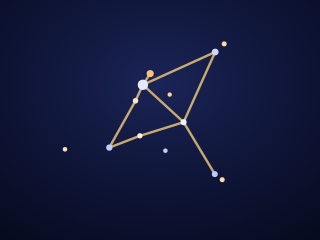 Aquila
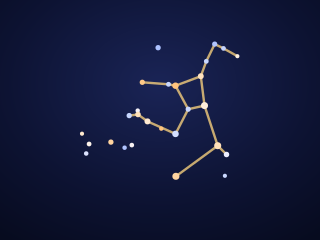 Hercules
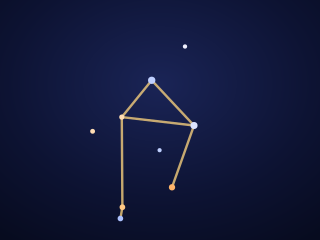 Libra
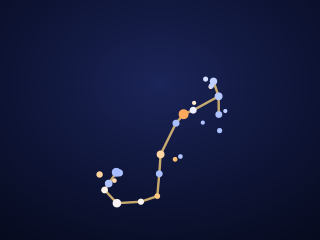 Scorpius
 Serpens
 Sagittarius