Aquila
Eagle
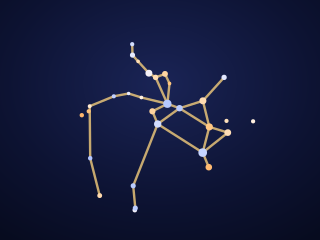
Aquila (Eagle), an eagle. A constellation near the celestial equator, visible from both hemispheres; in the evening it is at its best in August. Its brightest star is Altair.
Working out its position…
1How to find it
Aquila is one of the three corners of the Summer Triangle, the huge triangle it forms with Vega (in Lyra) and Deneb (in Cygnus). It is the southernmost corner. Its star Altair is easy to recognise: it is flanked by two fainter stars, Tarazed and Alshain, lined up with it like beads on a short necklace. The rest of the bird, wings spread, stretches across the Milky Way.
2The main stars
| Star | Name | Magnitude | Distance | Type |
|---|---|---|---|---|
| α Aquilae | Altair | 0.76 | 17 ly | A7IV · white subgiant |
| γ Aquilae | Tarazed | 2.72 | 395 ly | K3II · orange giant |
| ζ Aquilae | Okab | 2.99 | 83 ly | A0V · white, main sequence |
| θ Aquilae | — | 3.24 | 286 ly | B9.5III · blue-white giant |
| δ Aquilae | — | 3.36 | 51 ly | F0IV · yellow-white subgiant |
| λ Aquilae | — | 3.43 | 124 ly | B9V · blue-white, main sequence |
| β Aquilae | Alshain | 3.71 | 45 ly | G8IV · yellow subgiant |
| η Aquilae | — | 3.87 (variable 3.6–4.3) | 1,382 ly | F6Ib · yellow-white supergiant |
| ε Aquilae | — | 4.02 | 155 ly | K2III · orange giant |
| 12 Aquilae | — | 4.02 | 144 ly | K1III · orange giant |
The smaller the magnitude, the brighter the star. Distances come from the Hipparcos satellite; beyond a few hundred light-years they are approximate.
3Myth and origin of the name
To the Greeks, Aquila was the eagle of Zeus, the bird that carried his thunderbolts. One legend says the king of the gods took the shape of an eagle, or sent his bird, to carry off young Ganymede, the most handsome of mortals, and bring him to Olympus, where he became cupbearer to the gods. Ganymede is shown close by, in Aquarius.
In China and Japan, Altair tells a very different story. It is the Cowherd, a young man in love with the Weaver Girl, the star Vega. Separated by the Silver River, the Milky Way, they can meet only one night a year, on the seventh day of the seventh month, when magpies form a bridge over the water. The festival is called Qixi in China and Tanabata in Japan.
4History
It is one of the 48 constellations described by Claudius Ptolemy around AD 150 in the Almagest, the great treatise of Greek astronomy that remained the reference for more than a thousand years.
In 1784 the English astronomer Edward Pigott discovered that the star Eta Aquilae varies in brightness with great regularity: it was one of the first known Cepheids, the stars now used to measure distances in the Universe. In June 1918 a nova blazed there for a few days, almost as bright as Sirius.
Its present boundaries were drawn by the Belgian astronomer Eugène Delporte and adopted by the International Astronomical Union in 1930, like those of the other 87 constellations.
5Notable objects
6When to observe it
It is fully visible between latitudes 78° N and 71° S. In the evening around 10 pm, it is highest in the sky in August (seen from mid-northern latitudes).
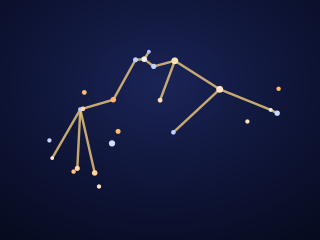 Aquarius
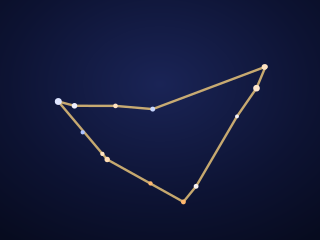 Capricornus
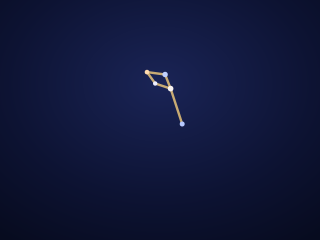 Delphinus
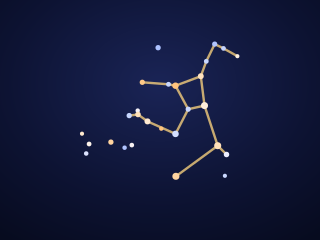 Hercules
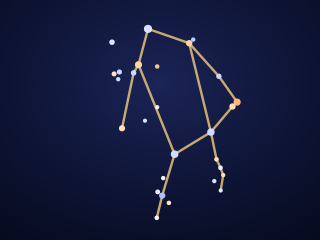 Ophiuchus
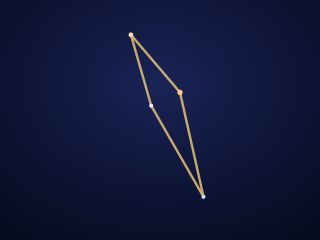 Scutum
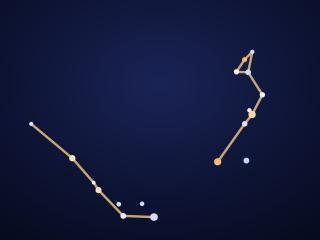 Serpens
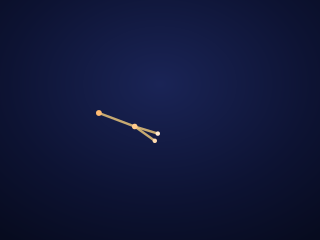 Sagitta
 Sagittarius