Scutum
Shield
Scutum (Shield), a shield. A constellation near the celestial equator, visible from both hemispheres; in the evening it is at its best in August. Its brightest star is α Scuti.
Working out its position…
1How to find it
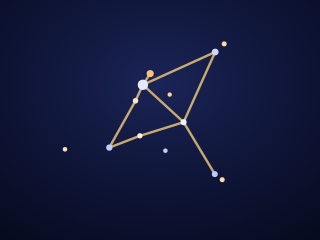
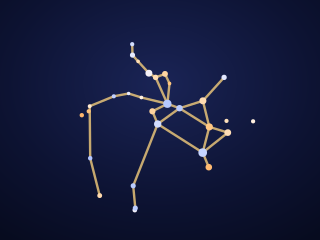
Scutum is a small constellation set in the middle of the Milky Way, between Aquila and Sagittarius. Its stars are faint, but it contains one of the finest parts of the Milky Way: the “Scutum Star Cloud”, a glowing patch easy to see on summer evenings from the countryside. To find it, extend the line of Aquila to the south-west, past Altair.
2The main stars
| Star | Name | Magnitude | Distance | Type |
|---|---|---|---|---|
| α Scuti | — | 3.85 | 199 ly | K2III · orange giant |
| β Scuti | — | 4.22 | 916 ly | G5II · yellow giant |
| ζ Scuti | — | 4.66 | 207 ly | K0III · orange giant |
| γ Scuti | — | 4.67 | 319 ly | A1IV · white subgiant |
| δ Scuti | — | 4.70 | 202 ly | F2III · yellow-white giant |
| η Scuti | — | 4.83 | 202 ly | K1III · orange giant |
| ε Scuti | — | 4.88 | 538 ly | G8II · yellow giant |
| HR 7119 | — | 5.08 | 1,400 ly | B3II · blue-white giant |
| HR 6970 | — | 5.12 | 329 ly | G8III · yellow giant |
| HR 7066 | — | 5.38 (variable 5.0–6.2) | — | K0Ib · orange supergiant |
The smaller the magnitude, the brighter the star. Distances come from the Hipparcos satellite; beyond a few hundred light-years they are approximate.
3Myth and origin of the name
Along with Coma Berenices, it is one of the two constellations that honour a person who really lived: Hevelius named it Scutum Sobiescianum, “Sobieski’s shield”, in honour of John III Sobieski, king of Poland. In 1683 Sobieski led the cavalry that relieved Vienna, besieged by the Ottoman army.
Hevelius also had a personal reason: the king had helped him rebuild his observatory in Danzig, destroyed by fire in 1679. The shield bears a cross, a symbol of the Christian victory at Vienna.
4History
The Danzig astronomer Johannes Hevelius created it to fill a gap between older constellations. It appears in his atlas Firmamentum Sobiescianum, published in 1690, three years after his death.
The cluster M11, nicknamed the “Wild Duck” in the 19th century by the English admiral William Smyth, who saw in it a V-shaped flight of ducks, is one of the richest open clusters in the sky. Scutum also contains UY Scuti, one of the largest stars known: placed at the centre of the Solar System, it would swallow the orbit of Mars with room to spare.
Its present boundaries were drawn by the Belgian astronomer Eugène Delporte and adopted by the International Astronomical Union in 1930, like those of the other 87 constellations.
5Notable objects
6When to observe it
It is fully visible from every latitude south of 74° N. In the evening around 10 pm, it is highest in the sky in August (seen from mid-northern latitudes).
 Aquila
 Serpens
 Sagittarius