Corona Borealis
Northern Crown
Corona Borealis (Northern Crown), a jewelled crown. A constellation of the northern sky; in the evening it is at its best in June. Its brightest star is Alphecca.
Working out its position…
1How to find it
Corona Borealis is a small, very recognisable semicircle of stars between Arcturus (in Boötes) and Vega, closer to Arcturus. Its central pearl, Alphecca (or Gemma, “the gem”), shines at magnitude 2.2. It is best seen on evenings from May to July, high in the sky. It looks like a tiara or an open necklace.
2The main stars
| Star | Name | Magnitude | Distance | Type |
|---|---|---|---|---|
| α Coronae Borealis | Alphecca | 2.22 | 75 ly | A0V · white, main sequence |
| β Coronae Borealis | Nusakan | 3.66 | 112 ly | F0 · yellow-white |
| γ Coronae Borealis | — | 3.81 | 146 ly | A1V · white, main sequence |
| θ Coronae Borealis | — | 4.14 | 375 ly | B6V · blue-white, main sequence |
| ε Coronae Borealis | — | 4.14 | 221 ly | K3III · orange giant |
| δ Coronae Borealis | — | 4.59 | 170 ly | G5III · yellow giant |
| ζ¹ Coronae Borealis | — | 4.64 | 473 ly | B7V · blue-white, main sequence |
| τ Coronae Borealis | — | 4.73 | 117 ly | K0III · orange giant |
| κ Coronae Borealis | — | 4.79 | 100 ly | K0III · orange giant |
| ξ Coronae Borealis | — | 4.86 | 183 ly | K0III · orange giant |
The smaller the magnitude, the brighter the star. Distances come from the Hipparcos satellite; beyond a few hundred light-years they are approximate.
3Myth and origin of the name
It is the crown of Ariadne, daughter of King Minos of Crete. Ariadne helped the Athenian hero Theseus get out of the Labyrinth after he had killed the Minotaur, thanks to a ball of thread he unwound behind him. She fled with him, but Theseus abandoned her, asleep, on the island of Naxos.
The god Dionysus found her there in tears and married her. For their wedding he gave her a crown made by Hephaestus, the blacksmith god. When Ariadne died, he threw the crown into the sky, where its jewels became stars.
4History
It is one of the 48 constellations described by Claudius Ptolemy around AD 150 in the Almagest, the great treatise of Greek astronomy that remained the reference for more than a thousand years.
It contains two remarkable stars. T Coronae Borealis is a “recurrent nova”: it flared up suddenly in 1866 and again in 1946, becoming visible to the naked eye, and astronomers keep a close watch for its returns, expected around the 2020s. R Coronae Borealis does the opposite: from time to time it almost disappears, hidden behind clouds of soot that it throws out.
Its present boundaries were drawn by the Belgian astronomer Eugène Delporte and adopted by the International Astronomical Union in 1930, like those of the other 87 constellations.
5Notable objects
No deep-sky object here is easy to see with small instruments: this is a region to explore with a telescope and a detailed chart.
6When to observe it
It is fully visible from every latitude north of 50° S. In the evening around 10 pm, it is highest in the sky in June (seen from mid-northern latitudes).
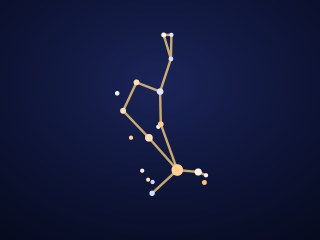 Boötes
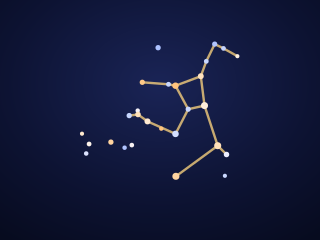 Hercules
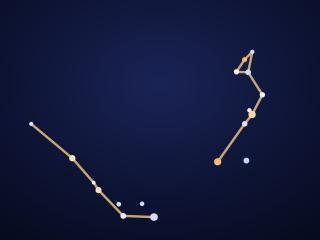 Serpens