Apus
Bird of Paradise
Apus (Bird of Paradise), a bird of paradise. A constellation of the southern sky; in the evening it is at its best in June. Its brightest star is α Apodis.
Working out its position…
1How to find it
Apus lies very close to the south celestial pole and can never be seen from Europe or North America. From the southern hemisphere, find Triangulum Australe, easy to spot near Alpha and Beta Centauri: Apus stretches just south of that triangle, between it and the pole. Its stars are faint; the brightest, Alpha, is an orange giant of magnitude 3.8.
2The main stars
| Star | Name | Magnitude | Distance | Type |
|---|---|---|---|---|
| α Apodis | — | 3.83 | 447 ly | K5III · orange giant |
| γ Apodis | — | 3.86 | 156 ly | K0IV · orange subgiant |
| β Apodis | — | 4.23 | 157 ly | K0III · orange giant |
| δ¹ Apodis | — | 4.68 (variable 4.6–4.8) | 762 ly | M5III · red giant |
| ζ Apodis | — | 4.76 | 297 ly | K1III · orange giant |
| η Apodis | — | 4.89 | 138 ly | A2 · white |
| ε Apodis | — | 5.06 | 645 ly | B4V · blue-white, main sequence |
| δ² Apodis | — | 5.27 | 613 ly | K3III · orange giant |
| HR 5540 | — | 5.37 | 374 ly | K4III · orange giant |
| ι Apodis | — | 5.39 | 1,320 ly | B8 · blue-white, main sequence |
The smaller the magnitude, the brighter the star. Distances come from the Hipparcos satellite; beyond a few hundred light-years they are approximate.
3Myth and origin of the name
Birds of paradise live in New Guinea and the nearby islands. In the 16th century traders sold their skins, with their splendid feathers, in Europe, often prepared without the feet. Europeans concluded that the birds had no legs, that they spent their whole life in the air and never landed.
The Latin name Apus indeed comes from the Greek apous, “footless”. The constellation preserves the memory of that legend born of a misunderstanding, and of the wonder of the first European travellers at the birds of the tropics.
4History
It grew out of the observations of the Dutch navigators Pieter Dirkszoon Keyser and Frederick de Houtman during the first Dutch voyage to the East Indies (1595–1597). The cartographer Petrus Plancius placed it on a celestial globe in 1598, and Johann Bayer included it in his atlas Uranometria in 1603.
On Plancius’s globe it was called Paradysvogel Apis Indica; Bayer later settled on the name Apus.
Its present boundaries were drawn by the Belgian astronomer Eugène Delporte and adopted by the International Astronomical Union in 1930, like those of the other 87 constellations.
5Notable objects
6When to observe it
It is fully visible from every latitude south of 7° N. It is never visible from mid-northern latitudes such as France (46° N): you have to travel south of about 7° N to see all of it. In the evening around 10 pm, it is highest in the sky in June (seen from mid-southern latitudes).
 Ara
 Chamaeleon
 Circinus
 Musca
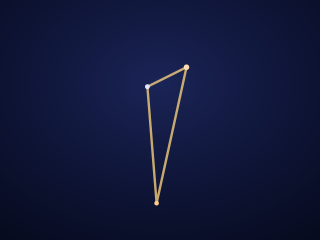 Octans
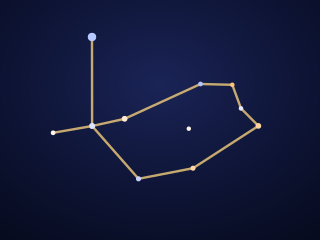 Pavo
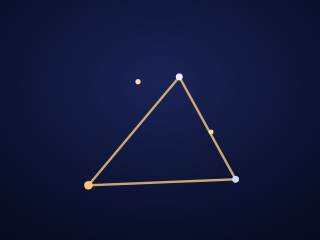 Triangulum Australe