Chamaeleon
Chameleon
Chamaeleon (Chameleon), a chameleon. A constellation of the southern sky; in the evening it is at its best in April. Its brightest star is α Chamaeleontis.
Working out its position…
1How to find it
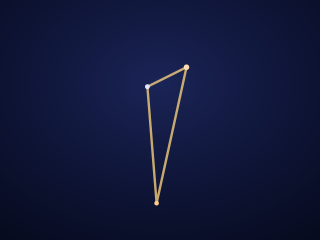
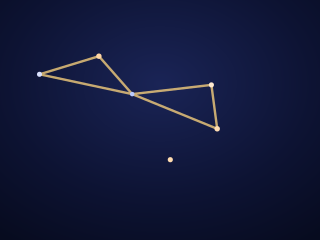
Chamaeleon is a small, faint constellation tucked very close to the south celestial pole, between Musca and Octans. It is never visible from Europe or North America. From the southern hemisphere, start at the Southern Cross, go through Musca just below it, then continue towards the pole: a small diamond of magnitude 4 stars marks the Chameleon.
2The main stars
| Star | Name | Magnitude | Distance | Type |
|---|---|---|---|---|
| α Chamaeleontis | — | 4.05 | 64 ly | F5III · yellow-white giant |
| γ Chamaeleontis | — | 4.11 | 418 ly | M0III · red giant |
| β Chamaeleontis | — | 4.24 | 298 ly | B5V · blue-white, main sequence |
| θ Chamaeleontis | — | 4.34 | 155 ly | K0III · orange giant |
| δ² Chamaeleontis | — | 4.45 | 351 ly | B2.5IV · blue-white subgiant |
| ε Chamaeleontis | — | 4.88 | 362 ly | B9V · blue-white, main sequence |
| κ Chamaeleontis | — | 5.04 | 477 ly | K4III · orange giant |
| ζ Chamaeleontis | — | 5.07 | 572 ly | B5V · blue-white, main sequence |
| ι Chamaeleontis | — | 5.34 | 190 ly | F3 · yellow-white subgiant |
| ν Chamaeleontis | — | 5.43 | 184 ly | G8III · yellow giant |
The smaller the magnitude, the brighter the star. Distances come from the Hipparcos satellite; beyond a few hundred light-years they are approximate.
3Myth and origin of the name
The chameleon, the lizard that can change colour and move its eyes independently, fascinated European travellers who came across it in Africa and Madagascar. The Dutch navigators placed it in the southern sky among other exotic animals they had encountered.
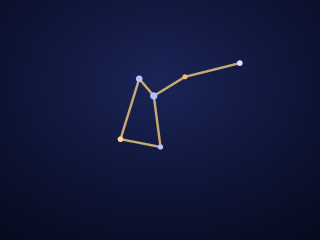
The arrangement is amusing: its neighbour is Musca, the Fly. In some atlases the chameleon even seems to stick out its tongue towards the insect, its favourite prey.
4History
It grew out of the observations of the Dutch navigators Pieter Dirkszoon Keyser and Frederick de Houtman during the first Dutch voyage to the East Indies (1595–1597). The cartographer Petrus Plancius placed it on a celestial globe in 1598, and Johann Bayer included it in his atlas Uranometria in 1603.
The area contains dark clouds of gas and dust, the Chamaeleon clouds, where new stars are being born; it is one of the closest star nurseries to the Sun, about 600 light-years away.
Its present boundaries were drawn by the Belgian astronomer Eugène Delporte and adopted by the International Astronomical Union in 1930, like those of the other 87 constellations.
5Notable objects
6When to observe it
It is fully visible from every latitude south of 7° N. It is never visible from mid-northern latitudes such as France (46° N): you have to travel south of about 7° N to see all of it. In the evening around 10 pm, it is highest in the sky in April (seen from mid-southern latitudes).
 Apus
 Carina
 Mensa
 Musca
 Octans
 Volans