Monoceros
Unicorn
Monoceros (Unicorn), a unicorn. A constellation near the celestial equator, visible from both hemispheres; in the evening it is at its best in February. Its brightest star is β Monocerotis.
Working out its position…
1How to find it
Monoceros hides inside the Winter Triangle, between Betelgeuse, Sirius and Procyon. Its stars are faint (none brighter than magnitude 3.9), but it is bathed in the winter Milky Way, rich in clusters and nebulae. Look for it on January to March evenings, due south from mid-northern latitudes.
2The main stars
| Star | Name | Magnitude | Distance | Type |
|---|---|---|---|---|
| β Monocerotis | — | 3.76 | 677 ly | B3V · blue-white, main sequence |
| α Monocerotis | — | 3.94 | 148 ly | K0III · orange giant |
| γ Monocerotis | — | 3.99 | 498 ly | K3III · orange giant |
| δ Monocerotis | — | 4.15 | 384 ly | A2V · white, main sequence |
| ζ Monocerotis | — | 4.36 | 1,059 ly | G2Ib · yellow supergiant |
| ε Monocerotis | — | 4.39 | 122 ly | A5IV · white subgiant |
| 13 Monocerotis | — | 4.47 | — | A0Ib · white supergiant |
| 18 Monocerotis | — | 4.48 | 368 ly | K0III · orange giant |
| 15 Monocerotis | — | 4.66 | 919 ly | O7 · blue |
| 28 Monocerotis | — | 4.69 | 450 ly | K4III · orange giant |
The smaller the magnitude, the brighter the star. Distances come from the Hipparcos satellite; beyond a few hundred light-years they are approximate.
3Myth and origin of the name
The unicorn, a legendary horse with a single horn on its forehead, appears in many stories of the Middle Ages and the Renaissance, where it symbolises purity. It was also mentioned in some old translations of the Bible, which appealed to its creator, Petrus Plancius.
It has no Greek myth. But it rounds off the great winter hunting scene nicely: Orion, his dogs and the hare, with a fabulous animal galloping in their midst.
4History
It was introduced by the Dutch theologian and cartographer Petrus Plancius, who filled areas of the sky left empty by the ancients.
Plancius drew it on a globe around 1612–1613. Monoceros contains the Rosette Nebula, the Christmas Tree Cluster and Hubble’s Variable Nebula, the subject of the first official photograph taken by the great Palomar telescope in 1949. Its star Beta is a trio of stars that William Herschel considered one of the most beautiful sights in the sky. In 2002 the star V838 Monocerotis suddenly swelled, and the light echo of the outburst lit up clouds of dust in spectacular fashion.
Its present boundaries were drawn by the Belgian astronomer Eugène Delporte and adopted by the International Astronomical Union in 1930, like those of the other 87 constellations.
5Notable objects
6When to observe it
It is fully visible between latitudes 79° N and 78° S. In the evening around 10 pm, it is highest in the sky in February (seen from mid-northern latitudes).
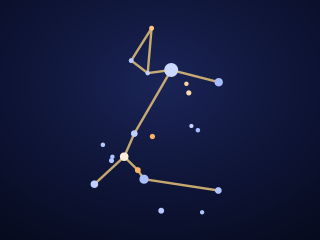 Canis Major
 Canis Minor
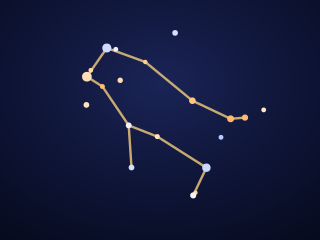 Gemini
 Hydra
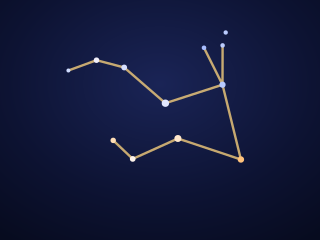 Lepus
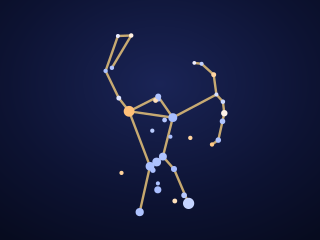 Orion
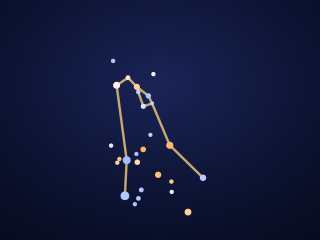 Puppis