Gemini
Twins
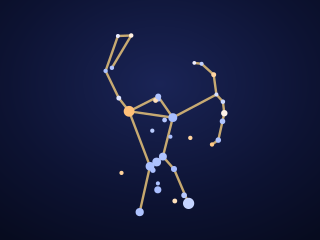
Gemini (Twins), twins. A constellation of the northern sky; in the evening it is at its best in February. Its brightest star is Pollux.
Working out its position…
1How to find it
Gemini is recognised by its two bright stars, Castor and Pollux, side by side north-east of Orion. Pollux, the southern one, is orange and slightly brighter; Castor is white. From these two heads two nearly parallel lines of stars run down towards Orion: the twins’ bodies. To find them, draw a line from Rigel to Betelgeuse and extend it. They are well placed from December to April.
2The main stars
| Star | Name | Magnitude | Distance | Type |
|---|---|---|---|---|
| β Geminorum | Pollux | 1.16 | 34 ly | K0III · orange giant |
| α Geminorum | Castor | 1.58 | 51 ly | A2V · white, main sequence |
| γ Geminorum | Alhena | 1.93 | 109 ly | A0IV · white subgiant |
| α Geminorum | Castor B | 2.85 | 52 ly | A · white |
| μ Geminorum | Tejat | 2.87 | 232 ly | M3III · red giant |
| ε Geminorum | Mebsuta | 3.06 | 845 ly | A3 · white |
| η Geminorum | Propus | 3.31 (variable 3.2–3.4) | 385 ly | M3III · red giant |
| ξ Geminorum | Alzirr | 3.35 | 59 ly | F5IV · yellow-white subgiant |
| δ Geminorum | Wasat | 3.50 | 60 ly | F0IV · yellow-white subgiant |
| κ Geminorum | — | 3.57 | 141 ly | G8III · yellow giant |
The smaller the magnitude, the brighter the star. Distances come from the Hipparcos satellite; beyond a few hundred light-years they are approximate.
3Myth and origin of the name
Castor and Pollux are the sons of Leda, queen of Sparta, and the brothers of Helen. But they did not have the same father: Castor was the son of King Tyndareus, and so mortal; Pollux was the son of Zeus, and so immortal. Inseparable, they joined the voyage of the Argonauts, where Pollux shone at boxing and Castor as a horseman.
When Castor was killed in a fight, the heartbroken Pollux begged Zeus to share his immortality with him. Zeus agreed: the two brothers now spend one day on Olympus and one day in the underworld, and shine together in the sky. Sailors called on them against storms, and the electric glows that sometimes appear at the tops of masts were named after them.
4History
It is one of the 48 constellations described by Claudius Ptolemy around AD 150 in the Almagest, the great treatise of Greek astronomy that remained the reference for more than a thousand years.
Castor is not one star but six: three pairs of stars orbiting one another. On 18 February 1930 the American Clyde Tombaugh discovered Pluto on photographs of the area around the star Delta Geminorum. Every year around 13 December, the Geminid meteor shower, one of the richest, seems to burst out near Castor; its dust comes from the asteroid Phaethon.
Its present boundaries were drawn by the Belgian astronomer Eugène Delporte and adopted by the International Astronomical Union in 1930, like those of the other 87 constellations.
5Notable objects
6When to observe it
It is fully visible from every latitude north of 55° S. In the evening around 10 pm, it is highest in the sky in February (seen from mid-northern latitudes).
 Auriga
 Canis Minor
 Cancer
 Lynx
 Monoceros
 Orion
 Taurus