Auriga
Charioteer
Auriga (Charioteer), a chariot driver. A constellation of the northern sky; in the evening it is at its best in January. Its brightest star is Capella.
Working out its position…
1How to find it
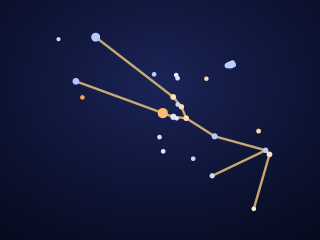
Auriga forms a large pentagon of stars, high in the sky on winter evenings, north of Orion. Its brightest corner, Capella, is the sixth brightest star in the sky and shines a golden yellow. Right next to Capella, a small triangle of fainter stars represents “the Kids”. The southern corner of the pentagon, Elnath, is shared with Taurus: it is the tip of one of the Bull’s horns.
From latitudes above about 45° N, Capella is circumpolar: it never sets and skims the northern horizon on summer evenings.
2The main stars
| Star | Name | Magnitude | Distance | Type |
|---|---|---|---|---|
| α Aurigae | Capella | 0.08 | 43 ly | M1 · red |
| HIP 0 | — | 0.96 | 42 ly | G0III · yellow giant |
| β Aurigae | Menkalinan | 1.90 | 81 ly | A2V · white, main sequence |
| θ Aurigae | Mahasim | 2.65 | 166 ly | A0 · white |
| ι Aurigae | Hassaleh | 2.69 | 493 ly | K3II · orange giant |
| ε Aurigae | Almaaz | 3.03 | 2,132 ly | F0Ia · yellow-white supergiant |
| η Aurigae | Haedus | 3.18 | 243 ly | B3V · blue-white, main sequence |
| ζ Aurigae | Saclateni | 3.69 | 786 ly | K4II · orange giant |
| δ Aurigae | — | 3.72 | 126 ly | K0III · orange giant |
| ν Aurigae | — | 3.97 | 230 ly | K0III · orange giant |
The smaller the magnitude, the brighter the star. Distances come from the Hipparcos satellite; beyond a few hundred light-years they are approximate.
3Myth and origin of the name
Auriga is often identified with Erichthonius, a legendary king of Athens and son of Hephaestus, the blacksmith god. Like his father he was lame; to get around he is said to have invented the quadriga, the chariot drawn by four horses. Admiring his ingenuity, Zeus placed him among the stars.
Oddly, the Charioteer is not shown with his chariot but carrying a goat on his shoulder and two young goats in his arms. The goat, Capella, recalls Amalthea, who fed the infant Zeus with her milk while he was hidden in Crete from his father Cronus. One of her horns, broken off, became the horn of plenty.
4History
It is one of the 48 constellations described by Claudius Ptolemy around AD 150 in the Almagest, the great treatise of Greek astronomy that remained the reference for more than a thousand years.
The star Epsilon Aurigae has puzzled astronomers for two centuries: every 27 years it dims for nearly two years. It is eclipsed by a companion hidden in a huge disc of dust; the last eclipse ran from 2009 to 2011 and the next is expected around 2036.
Its present boundaries were drawn by the Belgian astronomer Eugène Delporte and adopted by the International Astronomical Union in 1930, like those of the other 87 constellations.
5Notable objects
6When to observe it
It is fully visible from every latitude north of 34° S. In the evening around 10 pm, it is highest in the sky in January (seen from mid-northern latitudes).
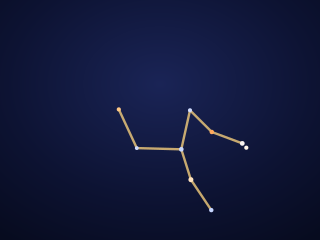 Camelopardalis
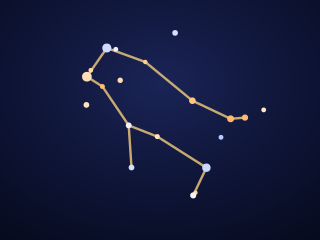 Gemini
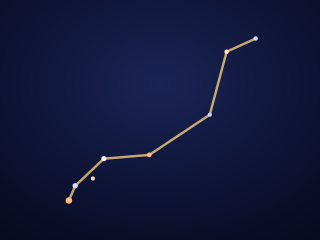 Lynx
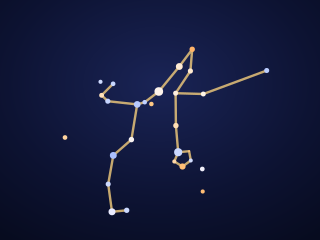 Perseus
 Taurus