Camelopardalis
Giraffe
Camelopardalis (Giraffe), a giraffe. A constellation of the northern sky; in the evening it is at its best in January. Its brightest star is β Camelopardalis.
Working out its position…
1How to find it
Camelopardalis is large but very faint: it fills the big empty space between Polaris, Cassiopeia, Perseus, Auriga and Ursa Major. None of its stars is brighter than magnitude 4. With binoculars, look for “Kemble’s Cascade”: a line of about twenty stars tumbling across the sky and ending at the small cluster NGC 1502. Circumpolar from mid-northern latitudes, it can be seen all year round, best in winter.
2The main stars
| Star | Name | Magnitude | Distance | Type |
|---|---|---|---|---|
| β Camelopardalis | — | 4.03 | 872 ly | G0Ib · yellow supergiant |
| HR 1035 | — | 4.21 | 1,941 ly | B9Ia · blue-white supergiant |
| α Camelopardalis | — | 4.26 | — | O9.5Ia · blue supergiant |
| HR 1155 | — | 4.39 | 796 ly | M1III · red giant |
| 7 Camelopardalis | — | 4.43 | 372 ly | A1V · white, main sequence |
| HR 1040 | — | 4.55 | 2,509 ly | A0Ia · white supergiant |
| HR 2527 | — | 4.55 | 184 ly | K4III · orange giant |
| γ Camelopardalis | — | 4.59 | 359 ly | A2IV · white subgiant |
| HR 985 | — | 4.74 | 762 ly | B2.5V · blue-white, main sequence |
| HR 2209 | — | 4.76 | 175 ly | A0V · white, main sequence |
The smaller the magnitude, the brighter the star. Distances come from the Hipparcos satellite; beyond a few hundred light-years they are approximate.
3Myth and origin of the name
The Latin word camelopardalis comes from Greek: the ancients pictured the giraffe as a cross between a camel, for its shape, and a leopard, for its spots. There is no Greek myth attached, because the constellation is recent.
Its creator, Petrus Plancius, was a clergyman who liked to draw his figures from the Bible. It has sometimes been said that his animal really stood for the camel that carried Rebecca to Isaac, but it is the outline of a giraffe that has stayed on the maps.
4History
It was introduced by the Dutch theologian and cartographer Petrus Plancius, who filled areas of the sky left empty by the ancients.
Plancius drew it on a globe around 1612–1613; the German Jakob Bartsch made it known by publishing it in 1624. Kemble’s Cascade is named after Father Lucian Kemble, a Canadian amateur astronomer who pointed it out to a columnist in 1980.
Its present boundaries were drawn by the Belgian astronomer Eugène Delporte and adopted by the International Astronomical Union in 1930, like those of the other 87 constellations.
5Notable objects
6When to observe it
It is fully visible from every latitude north of 4° S. From mid-northern latitudes such as France (46° N), it is circumpolar: it never sets and can be seen all year round. In the evening around 10 pm, it is highest in the sky in January (seen from mid-northern latitudes).
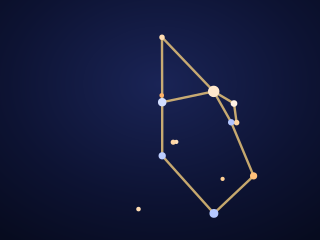 Auriga
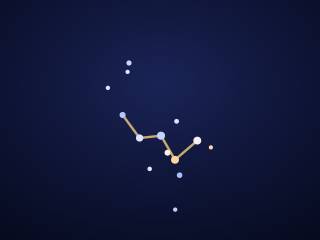 Cassiopeia
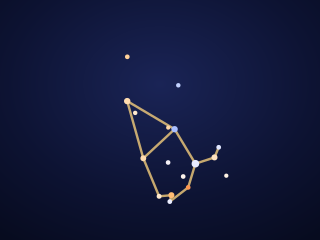 Cepheus
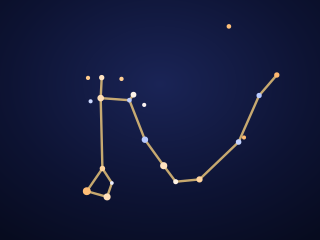 Draco
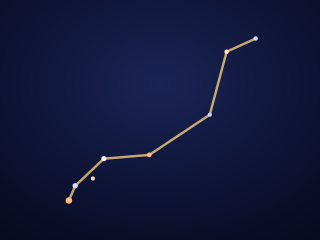 Lynx
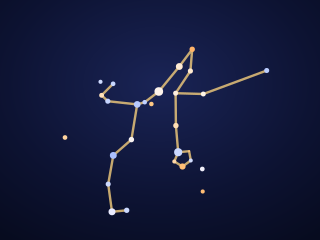 Perseus
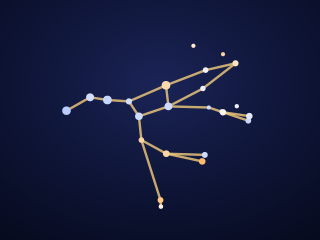 Ursa Major
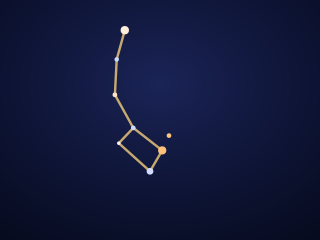 Ursa Minor