Cancer
Crab
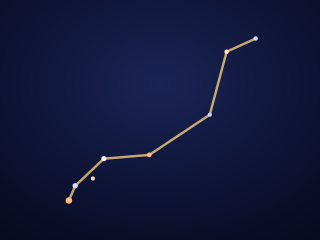
Cancer (Crab), a crab. A constellation of the northern sky; in the evening it is at its best in March. Its brightest star is Tarf.
Working out its position…
1How to find it
Cancer is the faintest of the zodiac constellations: none of its stars is brighter than magnitude 3.5. You find it halfway between Gemini (Castor and Pollux) and Leo (Regulus), on late-winter and spring evenings. Its treasure is nevertheless visible to the naked eye under a dark sky: in the middle, a small milky patch, the Beehive Cluster, framed by two magnitude 4 stars, the Donkeys.
2The main stars
| Star | Name | Magnitude | Distance | Type |
|---|---|---|---|---|
| β Cancri | Tarf | 3.53 | 303 ly | K4III · orange giant |
| δ Cancri | Asellus Australis | 3.94 | 131 ly | K0III · orange giant |
| ι Cancri | — | 4.03 | 331 ly | G8Ia · yellow supergiant |
| α Cancri | Acubens | 4.26 | 188 ly | A5 · white |
| γ Cancri | Asellus Borealis | 4.66 | 181 ly | A1IV · white subgiant |
| ζ² Cancri | Tegmine | 4.67 | 82 ly | G0V · yellow, main sequence |
| χ Cancri | — | 5.13 | 60 ly | F6V · yellow-white, main sequence |
| HR 3306 | — | 5.13 | 395 ly | G8II · yellow giant |
| 8 Cancri | — | 5.14 | 215 ly | A1V · white, main sequence |
| ξ Cancri | Nahn | 5.16 | 373 ly | K0III · orange giant |
The smaller the magnitude, the brighter the star. Distances come from the Hipparcos satellite; beyond a few hundred light-years they are approximate.
3Myth and origin of the name
During his second labour, Heracles was fighting the Hydra of Lerna, a many-headed water snake whose heads grew back as soon as they were cut off. The goddess Hera, who hated the hero, sent a giant crab to nip at his feet and distract him. Heracles crushed it with his heel. To reward the crab for its loyalty, Hera placed it among the stars, close to the Hydra.
The Greeks called the central cluster the “Manger”: the two stars beside it were two donkeys eating from it. It was said that a manger invisible on a clear night foretold rain, no doubt because the slightest haze is enough to hide it.
4History
It is one of the 48 constellations described by Claudius Ptolemy around AD 150 in the Almagest, the great treatise of Greek astronomy that remained the reference for more than a thousand years.
In 1609 and 1610 Galileo turned his telescope on the Beehive and counted about forty stars: the ancients’ “nebula” was a cluster. Two thousand years ago the Sun was in Cancer at the June solstice, hence the name “Tropic of Cancer” for the latitude where it is then overhead.
Its present boundaries were drawn by the Belgian astronomer Eugène Delporte and adopted by the International Astronomical Union in 1930, like those of the other 87 constellations.
5Notable objects
6When to observe it
It is fully visible from every latitude north of 57° S. In the evening around 10 pm, it is highest in the sky in March (seen from mid-northern latitudes).
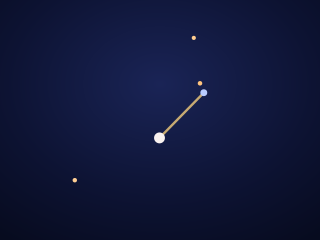 Canis Minor
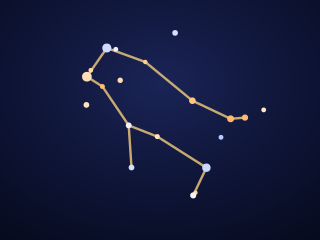 Gemini
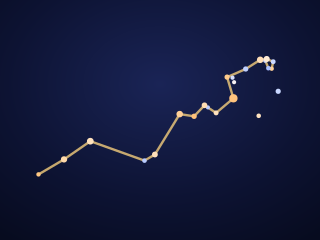 Hydra
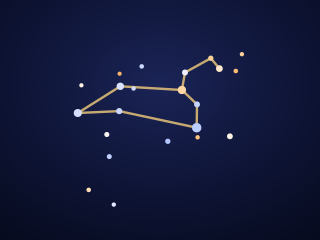 Leo
 Lynx