Canis Minor
Lesser Dog
Canis Minor (Lesser Dog), a little dog. A constellation near the celestial equator, visible from both hemispheres; in the evening it is at its best in February. Its brightest star is Procyon.
Working out its position…
1How to find it
Canis Minor comes down to two stars: Procyon, bright and yellowish-white, and the fainter Gomeisa right next to it. Procyon forms the large, almost equilateral Winter Triangle with Betelgeuse (in Orion) and Sirius (in Canis Major): it is the eastern corner, on the left when you face south.
2The main stars
| Star | Name | Magnitude | Distance | Type |
|---|---|---|---|---|
| α Canis Minoris | Procyon | 0.40 | 12 ly | F5IV · yellow-white subgiant |
| β Canis Minoris | Gomeisa | 2.89 | 162 ly | B8V · blue-white, main sequence |
| γ Canis Minoris | — | 4.33 | 318 ly | K3III · orange giant |
| HR 3145 | — | 4.39 | 254 ly | K2III · orange giant |
| 6 Canis Minoris | — | 4.55 | 572 ly | K2III · orange giant |
| ε Canis Minoris | — | 4.99 | 1,042 ly | G8III · yellow giant |
| ζ Canis Minoris | — | 5.12 | 624 ly | B8II · blue-white giant |
| η Canis Minoris | — | 5.22 | 318 ly | F0III · yellow-white giant |
| δ¹ Canis Minoris | — | 5.24 | 760 ly | F0III · yellow-white giant |
| 11 Canis Minoris | — | 5.25 | 301 ly | A1V · white, main sequence |
The smaller the magnitude, the brighter the star. Distances come from the Hipparcos satellite; beyond a few hundred light-years they are approximate.
3Myth and origin of the name
It is Orion’s second dog, smaller than Canis Major. Its star Procyon takes its name from the Greek for “before the dog”: seen from Greece, it rises a little before Sirius and announces it.
Another tradition sees Maera, the faithful dog of Icarius, the wine grower killed by drunken shepherds. She led Icarius’s daughter to her father’s body and died of grief beside him; the gods set her in the sky, while Icarius became Boötes.
4History
It is one of the 48 constellations described by Claudius Ptolemy around AD 150 in the Almagest, the great treatise of Greek astronomy that remained the reference for more than a thousand years.
Like Sirius, Procyon has a small white dwarf companion, predicted by Bessel in the 19th century and first seen in 1896. At 11.5 light-years, Procyon is one of our closest stellar neighbours.
Its present boundaries were drawn by the Belgian astronomer Eugène Delporte and adopted by the International Astronomical Union in 1930, like those of the other 87 constellations.
5Notable objects
No deep-sky object here is easy to see with small instruments: this is a region to explore with a telescope and a detailed chart.
6When to observe it
It is fully visible from every latitude north of 77° S. In the evening around 10 pm, it is highest in the sky in February (seen from mid-northern latitudes).
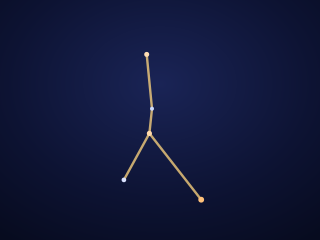 Cancer
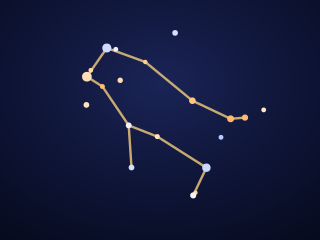 Gemini
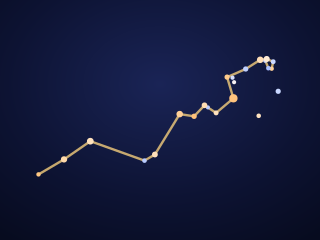 Hydra
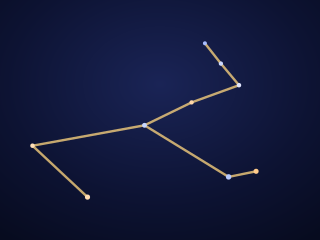 Monoceros