Canes Venatici
Hunting Dogs
Canes Venatici (Hunting Dogs), two hunting dogs. A constellation of the northern sky; in the evening it is at its best in May. Its brightest star is Cor Caroli.
Working out its position…
1How to find it
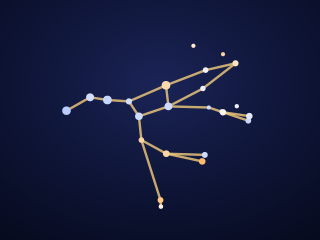
Canes Venatici hides just below the handle of the Big Dipper (Ursa Major). You mainly see one star, Cor Caroli, magnitude 2.9 and quite isolated: picture a line from the end of the handle towards the middle of the bowl, then drop about ten degrees south. A second, fainter star, Chara, forms the little pair of dogs with it.
2The main stars
| Star | Name | Magnitude | Distance | Type |
|---|---|---|---|---|
| α² Canum Venaticorum | Cor Caroli | 2.89 | 115 ly | A0 · white |
| β Canum Venaticorum | Chara | 4.24 | 28 ly | G0V · yellow, main sequence |
| 24 Canum Venaticorum | — | 4.68 | 180 ly | A5V · white, main sequence |
| 20 Canum Venaticorum | — | 4.72 | 264 ly | F3III · yellow-white giant |
| 5 Canum Venaticorum | — | 4.76 | 386 ly | G7III · yellow giant |
| HR 5219 | — | 4.76 | 601 ly | K5III · orange giant |
| 25 Canum Venaticorum | — | 4.82 | 199 ly | A7III · white giant |
| HR 5110 | — | 4.91 | 149 ly | F2IV · yellow-white subgiant |
| HR 4997 | — | 4.94 | 459 ly | K0III · orange giant |
| 6 Canum Venaticorum | — | 5.01 | 262 ly | G8III · yellow giant |
The smaller the magnitude, the brighter the star. Distances come from the Hipparcos satellite; beyond a few hundred light-years they are approximate.
3Myth and origin of the name
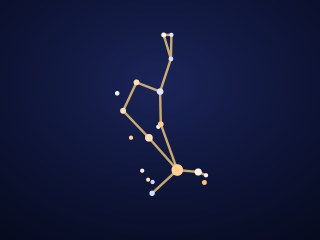
The Hunting Dogs have no ancient myth: Hevelius imagined them as companions for their neighbour Boötes, who thus seems to set his two dogs, Asterion and Chara, on the trail of the Bears around the pole. The scene completes a very old image of the northern sky, in which a keeper forever chases bears without ever catching them.
Its main star bears a royal name: Cor Caroli, “Charles’s Heart”. It is said to have been named in the 17th century in honour of a king of England, Charles I or his son Charles II depending on the account.
4History
The Danzig astronomer Johannes Hevelius created it to fill a gap between older constellations. It appears in his atlas Firmamentum Sobiescianum, published in 1690, three years after his death.
In 1845 the Irish astronomer William Parsons, Earl of Rosse, turned his giant 1.8-metre telescope on the object M51 and drew a spiral: it was the first time anyone had seen the spiral shape of a galaxy, then called a “spiral nebula”.
Its present boundaries were drawn by the Belgian astronomer Eugène Delporte and adopted by the International Astronomical Union in 1930, like those of the other 87 constellations.
5Notable objects
6When to observe it
It is fully visible from every latitude north of 38° S. In the evening around 10 pm, it is highest in the sky in May (seen from mid-northern latitudes).
 Boötes
 Coma Berenices
 Ursa Major