Coma Berenices
Berenice’s Hair
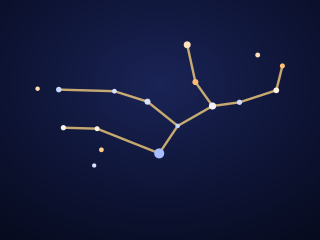
Coma Berenices (Berenice’s Hair), a queen’s hair. A constellation of the northern sky; in the evening it is at its best in May. Its brightest star is β Comae Berenices.
Working out its position…
1How to find it
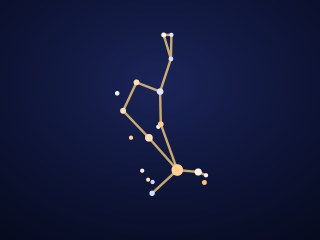
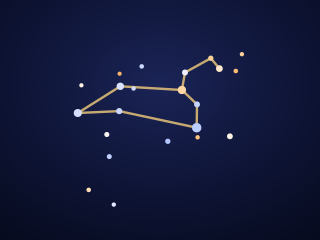
Coma Berenices fills the space between the Lion’s tail (Denebola), Arcturus and Cor Caroli. Its stars are faint, but under a dark sky you can see with the naked eye a delicate fan-shaped sprinkling of stars: the Coma Star Cluster, one of the nearest star clusters. Through binoculars this corner of the sky is lovely in spring.
2The main stars
| Star | Name | Magnitude | Distance | Type |
|---|---|---|---|---|
| β Comae Berenices | — | 4.23 | 30 ly | G0V · yellow, main sequence |
| α Comae Berenices | Diadem | 4.32 | 58 ly | F5V · yellow-white, main sequence |
| γ Comae Berenices | — | 4.35 | 167 ly | K2III · orange giant |
| 11 Comae Berenices | — | 4.72 | 290 ly | G8III · yellow giant |
| 36 Comae Berenices | — | 4.76 | 324 ly | M0III · red giant |
| 12 Comae Berenices | — | 4.78 | 295 ly | F8 · yellow-white |
| 23 Comae Berenices | — | 4.80 | 310 ly | A0IV · white subgiant |
| 41 Comae Berenices | — | 4.80 | 332 ly | K5III · orange giant |
| 37 Comae Berenices | — | 4.88 | 660 ly | K1III · orange giant |
| 35 Comae Berenices | — | 4.89 | 283 ly | G8III · yellow giant |
The smaller the magnitude, the brighter the star. Distances come from the Hipparcos satellite; beyond a few hundred light-years they are approximate.
3Myth and origin of the name
It is one of only two constellations that honour a person who really lived (the other is Scutum). Around 245 BC Queen Berenice II of Egypt promised to sacrifice her magnificent hair to the goddess Aphrodite if her husband, King Ptolemy III, came back safely from war. He returned, and Berenice laid her hair in a temple.
The next day it had vanished. To avoid the king’s anger, the court astronomer, Conon of Samos, declared that the goddess had carried it up to the sky and pointed to a small group of stars near the Lion’s tail. The poet Callimachus celebrated the event in a poem that the Roman Catullus later translated into Latin.
4History
Ptolemy still listed it as a detached part of Leo. It became a constellation in its own right on Caspar Vopel’s globe in 1536, then with Mercator and Tycho Brahe. The north pole of our galaxy lies here: looking in this direction we see out of the disc of the Milky Way, towards thousands of distant galaxies. It was while studying the Coma galaxy cluster that the Swiss astronomer Fritz Zwicky first suspected the existence of “dark matter” in 1933.
Its present boundaries were drawn by the Belgian astronomer Eugène Delporte and adopted by the International Astronomical Union in 1930, like those of the other 87 constellations.
5Notable objects
6When to observe it
It is fully visible from every latitude north of 57° S. In the evening around 10 pm, it is highest in the sky in May (seen from mid-northern latitudes).
 Boötes
 Canes Venatici
 Leo
 Ursa Major
 Virgo