Ursa Major
Great Bear
Ursa Major (Great Bear), a big bear. A constellation of the northern sky; in the evening it is at its best in April. Its brightest star is Alioth.
Working out its position…
1How to find it
Ursa Major contains the best-known asterism of the northern sky: seven bright stars forming the Plough, or Big Dipper. The four stars of the “bowl” form the bear’s body; the three of the “handle”, its long tail. The rest of the animal (head and legs) is drawn by fainter stars. At mid-northern latitudes it is circumpolar: high in spring, low in the north in autumn.
It is the starting point for finding the rest of the sky: extend the distance between Merak and Dubhe five times and you reach Polaris; follow the curve of the handle and you come to Arcturus, then Spica.
2The main stars
| Star | Name | Magnitude | Distance | Type |
|---|---|---|---|---|
| ε Ursae Majoris | Alioth | 1.76 | 83 ly | A0 · white |
| α Ursae Majoris | Dubhe | 1.81 | 123 ly | F7V · yellow-white, main sequence |
| η Ursae Majoris | Alkaid | 1.85 | 104 ly | B3V · blue-white, main sequence |
| ζ Ursae Majoris | Mizar | 2.23 | 86 ly | A2V · white, main sequence |
| β Ursae Majoris | Merak | 2.34 | 80 ly | A1V · white, main sequence |
| γ Ursae Majoris | Phecda | 2.41 | 83 ly | A0V · white, main sequence |
| ψ Ursae Majoris | — | 3.00 | 144 ly | K1III · orange giant |
| μ Ursae Majoris | Tania Australis | 3.06 | 230 ly | M0III · red giant |
| ι Ursae Majoris | Talitha | 3.12 | 47 ly | A7IV · white subgiant |
| θ Ursae Majoris | — | 3.17 | 44 ly | F6IV · yellow-white subgiant |
The smaller the magnitude, the brighter the star. Distances come from the Hipparcos satellite; beyond a few hundred light-years they are approximate.
3Myth and origin of the name
The nymph Callisto, a hunting companion of Artemis, was loved by Zeus and bore him a son, Arcas. To punish her, or to hide her depending on the account, she was turned into a bear. Years later Arcas, now a hunter, nearly killed his mother without recognising her. Zeus carried them both up to the sky: Callisto became the Great Bear, and Arcas the Little Bear or Boötes. Hera, furious, persuaded the sea gods never to let the bear bathe in the Ocean: that is why it never sets.
All over the northern hemisphere these seven stars tell stories. For the Romans they were seven plough oxen, the septem triones, which gave the word “septentrional”, meaning northern. In India they are the seven sages, the Saptarishi; in China, the Northern Dipper. For the Mi’kmaq of Canada, the bowl is a bear chased by three hunters, the stars of the handle.
4History
It is one of the 48 constellations described by Claudius Ptolemy around AD 150 in the Almagest, the great treatise of Greek astronomy that remained the reference for more than a thousand years.
Mizar, in the middle of the handle, forms a pair with Alcor that sharp eyes can split without a telescope. In a telescope Mizar splits again: it was one of the first double stars discovered, in the 17th century, and then, in 1889, the first “spectroscopic” double star, detected by analysing its light. Five of the seven stars of the Plough travel together through space; Dubhe and Alkaid are heading in other directions, so that in 100,000 years the pattern will be bent out of shape.
Its present boundaries were drawn by the Belgian astronomer Eugène Delporte and adopted by the International Astronomical Union in 1930, like those of the other 87 constellations.
5Notable objects
6When to observe it
It is fully visible from every latitude north of 17° S. In the evening around 10 pm, it is highest in the sky in April (seen from mid-northern latitudes).
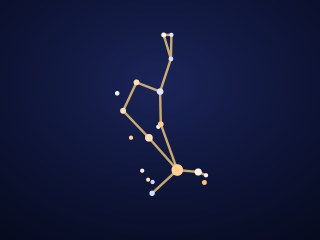 Boötes
 Canes Venatici
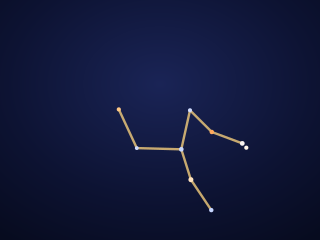 Camelopardalis
 Coma Berenices
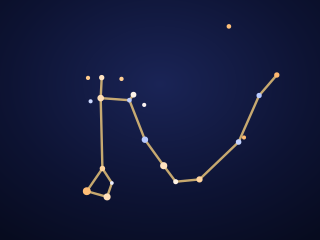 Draco
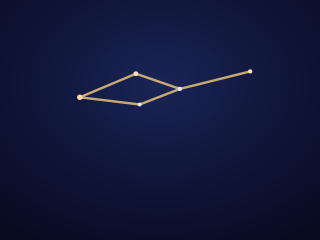 Leo Minor
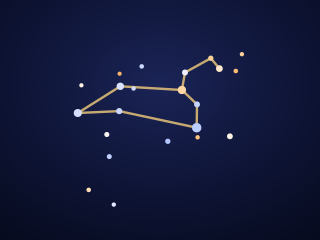 Leo
 Lynx