Tucana
Toucan
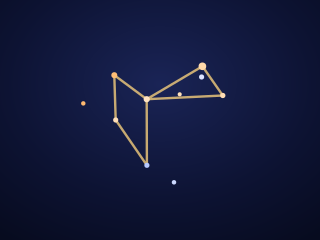
Tucana (Toucan), a toucan. A constellation of the southern sky; in the evening it is at its best in October. Its brightest star is α Tucanae.
Working out its position…
1How to find it
Tucana lies near the south celestial pole, between Achernar and Grus. Its stars are modest, but it contains two treasures visible to the naked eye: the Small Magellanic Cloud, a small neighbouring galaxy that looks like a cloud broken off the Milky Way, and right next to it the cluster 47 Tucanae, which looks like a fuzzy star. It is not visible from Europe or North America.
2The main stars
| Star | Name | Magnitude | Distance | Type |
|---|---|---|---|---|
| α Tucanae | — | 2.87 | 200 ly | K3III · orange giant |
| γ Tucanae | — | 3.99 | 75 ly | F1III · yellow-white giant |
| ζ Tucanae | — | 4.23 | 28 ly | F9V · yellow-white, main sequence |
| κ Tucanae | — | 4.25 | 68 ly | F6IV · yellow-white subgiant |
| β¹ Tucanae | — | 4.36 | 135 ly | B9V · blue-white, main sequence |
| ε Tucanae | — | 4.49 | 373 ly | B9IV · blue-white subgiant |
| δ Tucanae | — | 4.51 | 251 ly | B8V · blue-white, main sequence |
| β² Tucanae | — | 4.53 | 168 ly | A2V · white, main sequence |
| ν Tucanae | — | 4.91 (variable 4.8–5.0) | 290 ly | M4III · red giant |
| η Tucanae | — | 5.00 | 155 ly | A1V · white, main sequence |
The smaller the magnitude, the brighter the star. Distances come from the Hipparcos satellite; beyond a few hundred light-years they are approximate.
3Myth and origin of the name
The toucan, with its huge colourful bill, lives in the forests of tropical America. The Dutch navigators, who had probably seen birds or engravings from Brazil, placed it in the southern sky among other exotic birds: Grus, Phoenix, Pavo and Apus.
The bird seems to watch over the Small Magellanic Cloud, tucked under its wing. For many peoples of the southern hemisphere, the two Magellanic Clouds were characters or celestial camps, watched long before Europeans arrived.
4History
It grew out of the observations of the Dutch navigators Pieter Dirkszoon Keyser and Frederick de Houtman during the first Dutch voyage to the East Indies (1595–1597). The cartographer Petrus Plancius placed it on a celestial globe in 1598, and Johann Bayer included it in his atlas Uranometria in 1603.
The cluster 47 Tucanae (NGC 104) is the second finest globular cluster in the sky after Omega Centauri; it lies about 15,000 light-years away, much closer than the Small Magellanic Cloud (200,000 light-years) in front of which it appears to sit.
Its present boundaries were drawn by the Belgian astronomer Eugène Delporte and adopted by the International Astronomical Union in 1930, like those of the other 87 constellations.
5Notable objects
6When to observe it
It is fully visible from every latitude south of 15° N. It is never visible from mid-northern latitudes such as France (46° N): you have to travel south of about 15° N to see all of it. In the evening around 10 pm, it is highest in the sky in October (seen from mid-southern latitudes).
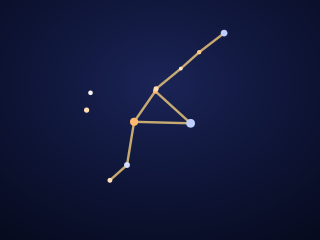 Grus
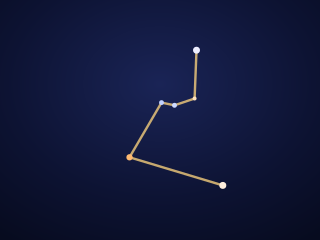 Hydrus
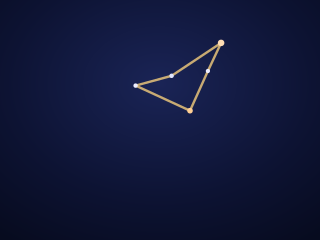 Indus
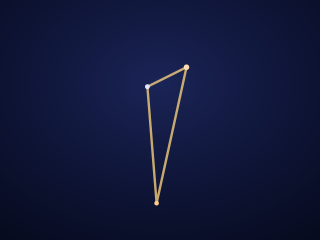 Octans
 Phoenix