Phoenix
Phoenix
Phoenix, a firebird. A constellation of the southern sky; in the evening it is at its best in November. Its brightest star is Ankaa.
Working out its position…
1How to find it
Phoenix is a southern constellation between Achernar and Fomalhaut. Its main star, Ankaa, shines at magnitude 2.4. From southern Europe its northern end skims the horizon on October and November evenings; you can see all of it south of about latitude 32° N. Look for Ankaa below the tail of Cetus and east of Grus.
2The main stars
| Star | Name | Magnitude | Distance | Type |
|---|---|---|---|---|
| α Phoenicis | Ankaa | 2.40 | 85 ly | K0III · orange giant |
| β Phoenicis | — | 3.32 | — | G8III · yellow giant |
| γ Phoenicis | — | 3.41 | 234 ly | K5II · orange giant |
| ε Phoenicis | — | 3.88 | 144 ly | K0III · orange giant |
| κ Phoenicis | — | 3.93 | 78 ly | A7V · white, main sequence |
| δ Phoenicis | — | 3.93 | 142 ly | K0III · orange giant |
| ζ Phoenicis | Wurren | 3.94 (variable 3.9–4.2) | 299 ly | B6V · blue-white, main sequence |
| η Phoenicis | — | 4.36 | 246 ly | A0IV · white subgiant |
| ψ Phoenicis | — | 4.39 | 342 ly | M4III · red giant |
| μ Phoenicis | — | 4.59 | 246 ly | G8III · yellow giant |
The smaller the magnitude, the brighter the star. Distances come from the Hipparcos satellite; beyond a few hundred light-years they are approximate.
3Myth and origin of the name
The phoenix is a fabulous bird, described in antiquity by the Greek historian Herodotus, who linked it to Egypt. According to legend it lived for several centuries, then built a nest of spices that burst into flame. From its ashes a young phoenix was reborn, which carried its father’s remains to the temple of the Sun.
The Dutch navigators placed this firebird, a symbol of rebirth, in the southern sky. Before them, Arab astronomers saw a boat or a group of ostriches in these stars.
4History
It grew out of the observations of the Dutch navigators Pieter Dirkszoon Keyser and Frederick de Houtman during the first Dutch voyage to the East Indies (1595–1597). The cartographer Petrus Plancius placed it on a celestial globe in 1598, and Johann Bayer included it in his atlas Uranometria in 1603.
The name Ankaa comes from Arabic and refers to a legendary bird. In 2012 a galaxy cluster was discovered in Phoenix where stars are forming at a record rate, around a giant galaxy.
Its present boundaries were drawn by the Belgian astronomer Eugène Delporte and adopted by the International Astronomical Union in 1930, like those of the other 87 constellations.
5Notable objects
6When to observe it
It is fully visible from every latitude south of 32° N. From mid-northern latitudes such as France (46° N), only its northern part rises above the southern horizon; to see all of it you need to be south of latitude 32° N. In the evening around 10 pm, it is highest in the sky in November (seen from mid-northern latitudes).
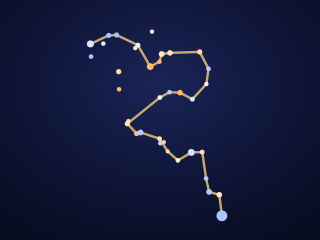 Eridanus
 Fornax
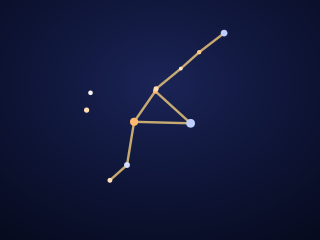 Grus
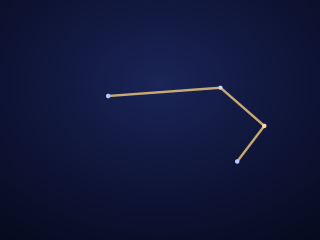 Sculptor
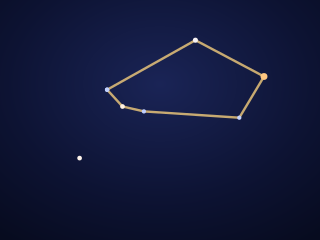 Tucana