Fornax
Furnace
Fornax (Furnace), a chemist’s furnace. A constellation of the southern sky; in the evening it is at its best in December. Its brightest star is Dalim.
Working out its position…
1How to find it
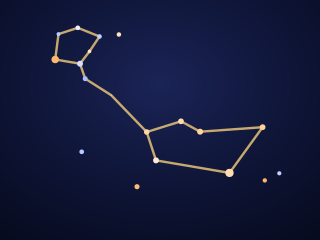
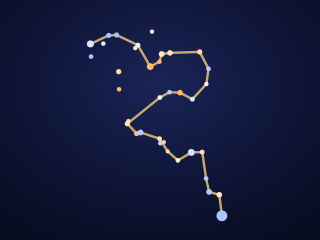
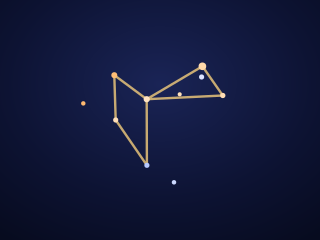
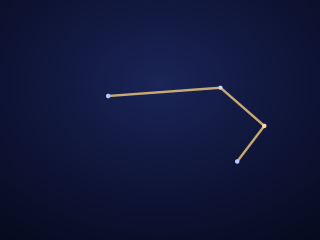
Fornax is a faint constellation of the southern sky, set inside a loop of Eridanus, south of Cetus. Its brightest star, Alpha, only reaches magnitude 3.9. From mid-northern latitudes it appears low in the south on November and December evenings, under a dark sky; it lies roughly between Diphda (in Cetus) and Achernar.
2The main stars
| Star | Name | Magnitude | Distance | Type |
|---|---|---|---|---|
| α Fornacis | Dalim | 3.80 | 46 ly | F8V · yellow-white, main sequence |
| β Fornacis | — | 4.45 | 173 ly | G8III · yellow giant |
| ν Fornacis | — | 4.68 | 371 ly | B9.5 · blue-white |
| ω Fornacis | — | 4.96 | 484 ly | B9V · blue-white, main sequence |
| δ Fornacis | — | 4.99 | 847 ly | B5III · blue-white giant |
| φ Fornacis | — | 5.13 | 152 ly | A2 · white, main sequence |
| κ Fornacis | — | 5.19 | 72 ly | G2V · yellow, main sequence |
| μ Fornacis | — | 5.27 | 320 ly | A0V · white, main sequence |
| π Fornacis | — | 5.34 | 294 ly | G8III · yellow giant |
| γ² Fornacis | — | 5.39 | 459 ly | A1V · white, main sequence |
The smaller the magnitude, the brighter the star. Distances come from the Hipparcos satellite; beyond a few hundred light-years they are approximate.
3Myth and origin of the name
Lacaille named it “the Chemical Furnace”: the laboratory oven, with its still, that chemists used to heat, distil and transform matter. In the 18th century chemistry was booming and gradually breaking away from alchemy.
So there is no myth, but a nod to a science being born. A few years after Lacaille’s death, Antoine Lavoisier would revolutionise chemistry with exactly this kind of furnace and balance.
4History
The French astronomer Nicolas-Louis de Lacaille created it after charting nearly 10,000 southern stars from the Cape of Good Hope in 1751 and 1752. Like his thirteen other constellations, it honours an instrument of the sciences or the arts; it appears on his planisphere of 1756.
This apparently empty corner of sky is a window on the distant Universe: it holds the Fornax galaxy cluster, about 60 million light-years away, and a small satellite galaxy of ours. In 2004 the Hubble Space Telescope took the “Ultra Deep Field” here, a picture showing thousands of galaxies, some of them seen as they were more than 13 billion years ago.
Its present boundaries were drawn by the Belgian astronomer Eugène Delporte and adopted by the International Astronomical Union in 1930, like those of the other 87 constellations.
5Notable objects
6When to observe it
It is fully visible from every latitude south of 50° N. In the evening around 10 pm, it is highest in the sky in December (seen from mid-northern latitudes).
 Cetus
 Eridanus
 Phoenix
 Sculptor