Pictor
Painter’s Easel
Pictor (Painter’s Easel), a painter’s easel. A constellation of the southern sky; in the evening it is at its best in January. Its brightest star is α Pictoris.
Working out its position…
1How to find it
Pictor (the Painter’s Easel) is a faint constellation of the southern sky next to Canopus, between Carina and Dorado. Its three main stars form a long, narrow triangle. From the southern hemisphere, start at Canopus and slide westwards. It is practically invisible from Europe and North America.
2The main stars
| Star | Name | Magnitude | Distance | Type |
|---|---|---|---|---|
| α Pictoris | — | 3.24 | 97 ly | A7IV · white subgiant |
| β Pictoris | — | 3.85 | 63 ly | A3V · white, main sequence |
| γ Pictoris | — | 4.50 | 177 ly | K1III · orange giant |
| δ Pictoris | — | 4.72 (variable 4.7–4.9) | 1,299 ly | B0.5IV · blue-white subgiant |
| HR 2196 | — | 5.04 | 362 ly | K2 · orange giant |
| η² Pictoris | — | 5.05 | 444 ly | M2III · red giant |
| HR 2049 | — | 5.16 | 256 ly | G8III · yellow giant |
| HR 2389 | — | 5.20 | 304 ly | K0III · orange giant |
| HR 2094 | — | 5.29 | 113 ly | F0V · yellow-white, main sequence |
| λ Pictoris | — | 5.30 | 374 ly | K0 · orange giant |
The smaller the magnitude, the brighter the star. Distances come from the Hipparcos satellite; beyond a few hundred light-years they are approximate.
3Myth and origin of the name
Lacaille called it “the Easel and Palette”, in honour of painters. In the 18th century artists and scientists often worked together: good draughtsmen were needed to depict discoveries, instruments… and constellations faithfully.
It is one of the few constellations devoted to the arts rather than the sciences, along with Sculptor. Its full Latin name, Equuleus Pictoris, meant “the painter’s little horse”, in other words his easel; it was shortened to Pictor.
4History
The French astronomer Nicolas-Louis de Lacaille created it after charting nearly 10,000 southern stars from the Cape of Good Hope in 1751 and 1752. Like his thirteen other constellations, it honours an instrument of the sciences or the arts; it appears on his planisphere of 1756.
The star Beta Pictoris is famous: in 1984 a disc of dust seen edge-on was photographed around it, the first around another star; then in 2008 a team led by the French astronomer Anne-Marie Lagrange obtained an image of a giant planet there. Pictor also contains Kapteyn’s Star, an old nearby star (13 light-years) that is crossing the disc of our galaxy at high speed.
Its present boundaries were drawn by the Belgian astronomer Eugène Delporte and adopted by the International Astronomical Union in 1930, like those of the other 87 constellations.
5Notable objects
No deep-sky object here is easy to see with small instruments: this is a region to explore with a telescope and a detailed chart.
6When to observe it
It is fully visible from every latitude south of 26° N. From mid-northern latitudes such as France (46° N), only its northern part rises above the southern horizon; to see all of it you need to be south of latitude 26° N. In the evening around 10 pm, it is highest in the sky in January (seen from mid-northern latitudes).
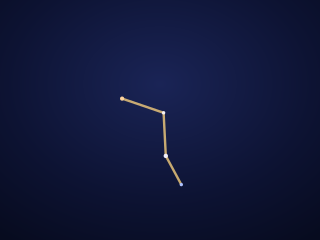 Caelum
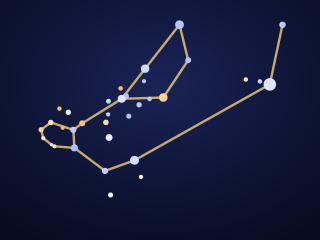 Carina
 Columba
 Dorado
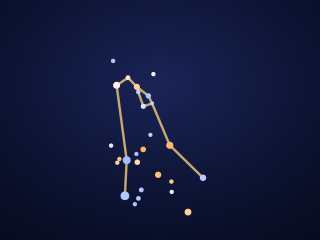 Puppis
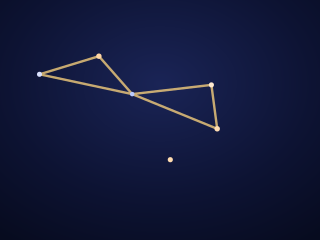 Volans