Hydrus
Lesser Water Snake
Hydrus (Lesser Water Snake), a small water snake. A constellation of the southern sky; in the evening it is at its best in November. Its brightest star is β Hydri.
Working out its position…
1How to find it
Hydrus is a shorter snake than Hydra, very close to the south celestial pole, between the two Magellanic Clouds and Achernar. Its three main stars, of magnitude 2.8 to 3.2, form a large triangle that is easy to spot from the southern hemisphere. It is never visible from Europe or North America.
2The main stars
| Star | Name | Magnitude | Distance | Type |
|---|---|---|---|---|
| β Hydri | — | 2.82 | 24 ly | G2IV · yellow subgiant |
| α Hydri | — | 2.86 | 72 ly | F0V · yellow-white, main sequence |
| γ Hydri | — | 3.26 | 214 ly | M2III · red giant |
| δ Hydri | — | 4.08 | 140 ly | A3V · white, main sequence |
| ε Hydri | — | 4.12 | 152 ly | B9III · blue-white giant |
| η² Hydri | — | 4.68 | 219 ly | G5III · yellow giant |
| ν Hydri | — | 4.76 | 339 ly | K3III · orange giant |
| ζ Hydri | — | 4.83 | 284 ly | A2IV · white subgiant |
| λ Hydri | — | 5.09 | 212 ly | K5III · orange giant |
| μ Hydri | — | 5.27 | 284 ly | G4III · yellow giant |
The smaller the magnitude, the brighter the star. Distances come from the Hipparcos satellite; beyond a few hundred light-years they are approximate.
3Myth and origin of the name
The Dutch navigators placed this little water snake in the southern sky, perhaps inspired by the sea snakes they saw during their long voyages. To tell it apart from the Hydra of Lerna it was called the male Hydra, Hydrus.
It has no legend of its own. It wriggles between the two Magellanic Clouds, as if slipping between two milky islands in the celestial ocean.
4History
It grew out of the observations of the Dutch navigators Pieter Dirkszoon Keyser and Frederick de Houtman during the first Dutch voyage to the East Indies (1595–1597). The cartographer Petrus Plancius placed it on a celestial globe in 1598, and Johann Bayer included it in his atlas Uranometria in 1603.
Its star Beta, 24 light-years away, is the nearby star that most resembles what our Sun will become: a little older and more evolved, it gives an idea of the Sun’s future in one or two billion years.
Its present boundaries were drawn by the Belgian astronomer Eugène Delporte and adopted by the International Astronomical Union in 1930, like those of the other 87 constellations.
5Notable objects
No deep-sky object here is easy to see with small instruments: this is a region to explore with a telescope and a detailed chart.
6When to observe it
It is fully visible from every latitude south of 8° N. It is never visible from mid-northern latitudes such as France (46° N): you have to travel south of about 8° N to see all of it. In the evening around 10 pm, it is highest in the sky in November (seen from mid-southern latitudes).
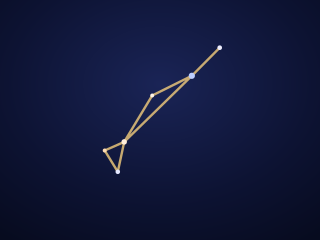 Dorado
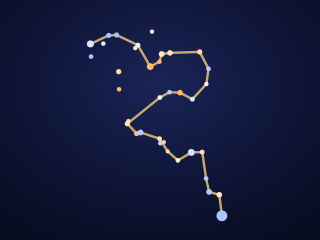 Eridanus
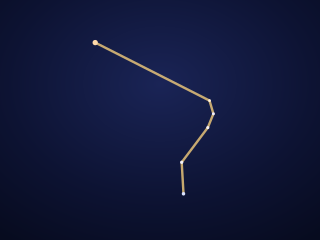 Horologium
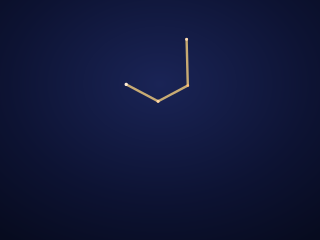 Mensa
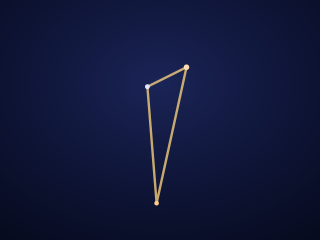 Octans
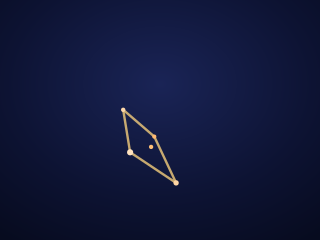 Reticulum
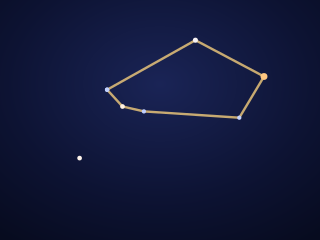 Tucana