Reticulum
Reticle
Reticulum (Reticle), a small sighting grid. A constellation of the southern sky; in the evening it is at its best in December. Its brightest star is α Reticuli.
Working out its position…
1How to find it
Reticulum is a tiny diamond-shaped southern constellation between Horologium and Dorado, near the Large Magellanic Cloud. Its stars of magnitude 3 to 5 make a small kite that is easy to spot from the southern hemisphere. It is not visible from Europe or North America.
2The main stars
| Star | Name | Magnitude | Distance | Type |
|---|---|---|---|---|
| α Reticuli | — | 3.33 | 162 ly | G7III · yellow giant |
| β Reticuli | — | 3.84 | 97 ly | K0IV · orange subgiant |
| ε Reticuli | — | 4.44 | 60 ly | K2IV · orange subgiant |
| γ Reticuli | — | 4.48 | 469 ly | M4III · red giant |
| δ Reticuli | — | 4.56 | 526 ly | M2III · red giant |
| κ Reticuli | — | 4.71 | 71 ly | F5IV · yellow-white subgiant |
| ι Reticuli | — | 4.97 | 319 ly | K4III · orange giant |
| ζ² Reticuli | — | 5.24 | 39 ly | G1V · yellow, main sequence |
| η Reticuli | — | 5.24 | 385 ly | G7III · yellow giant |
| HR 1340 | — | 5.45 | 263 ly | K0III · orange giant |
The smaller the magnitude, the brighter the star. Distances come from the Hipparcos satellite; beyond a few hundred light-years they are approximate.
3Myth and origin of the name
Reticulum honours a tiny but essential accessory: the grid of very fine threads placed in a telescope eyepiece to measure star positions precisely. Lacaille used a diamond-shaped reticle during his stay at the Cape of Good Hope.
Putting this tool in the sky was a salute to precision: thanks to these few crossed threads, Lacaille catalogued nearly 10,000 southern stars in under two years.
4History
The French astronomer Nicolas-Louis de Lacaille created it after charting nearly 10,000 southern stars from the Cape of Good Hope in 1751 and 1752. Like his thirteen other constellations, it honours an instrument of the sciences or the arts; it appears on his planisphere of 1756.
Zeta Reticuli is a lovely pair of two Sun-like stars, about 39 light-years away, visible to the naked eye as a double star under a dark sky.
Its present boundaries were drawn by the Belgian astronomer Eugène Delporte and adopted by the International Astronomical Union in 1930, like those of the other 87 constellations.
5Notable objects
6When to observe it
It is fully visible from every latitude south of 23° N. It is never visible from mid-northern latitudes such as France (46° N): you have to travel south of about 23° N to see all of it. In the evening around 10 pm, it is highest in the sky in December (seen from mid-southern latitudes).
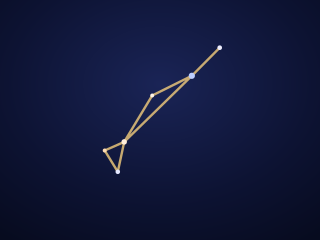 Dorado
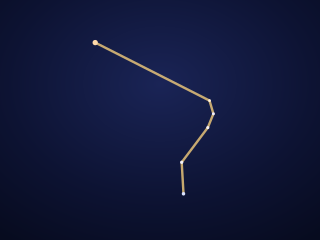 Horologium
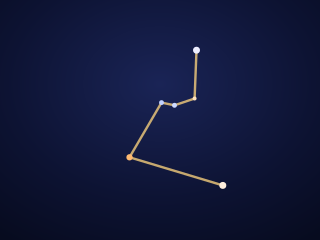 Hydrus