Pegasus
Pegasus
Pegasus, a winged horse. A constellation of the northern sky; in the evening it is at its best in October. Its brightest star is Enif.
Working out its position…
1How to find it
Pegasus is recognised by its Great Square, four stars of magnitude 2 to 3 forming a huge quadrilateral, high in the sky on autumn evenings. The north-eastern corner, Alpheratz, officially belongs to Andromeda. The horse is seen upside down: from the south-western corner, Markab, a line of stars runs west to Enif, the nose, while two lines from Scheat draw the front legs.
2The main stars
| Star | Name | Magnitude | Distance | Type |
|---|---|---|---|---|
| ε Pegasi | Enif | 2.38 | 690 ly | K2Ib · orange supergiant |
| β Pegasi | Scheat | 2.44 (variable 2.4–2.6) | 196 ly | M2II · red giant |
| α Pegasi | Markab | 2.49 | 133 ly | B9.5III · blue-white giant |
| γ Pegasi | Algenib | 2.83 | 392 ly | B2IV · blue-white subgiant |
| η Pegasi | Matar | 2.93 | 214 ly | G2II · yellow giant |
| ζ Pegasi | Homam | 3.41 | 204 ly | B8.5V · blue-white, main sequence |
| μ Pegasi | Sadalbari | 3.51 | 106 ly | M2III · red giant |
| θ Pegasi | Biham | 3.52 | 92 ly | A2V · white, main sequence |
| ι Pegasi | — | 3.77 | 38 ly | F5V · yellow-white, main sequence |
| λ Pegasi | — | 3.97 | 365 ly | G8II · yellow giant |
The smaller the magnitude, the brighter the star. Distances come from the Hipparcos satellite; beyond a few hundred light-years they are approximate.
3Myth and origin of the name
Pegasus, the winged horse, sprang from the blood of the Gorgon Medusa when Perseus cut off her head. With a stamp of his hoof on Mount Helicon he made the Hippocrene spring gush out, where poets came for inspiration.
The hero Bellerophon managed to tame him with a golden bridle given by Athena, and together they defeated the Chimera, a fire-breathing monster. But Bellerophon, carried away, tried to ride up to Olympus. Zeus sent a gadfly to sting Pegasus, who threw his rider. The horse carried on up to the gods and became the bearer of Zeus’s thunderbolts.
4History
It is one of the 48 constellations described by Claudius Ptolemy around AD 150 in the Almagest, the great treatise of Greek astronomy that remained the reference for more than a thousand years.
In 1995 two Swiss astronomers, Michel Mayor and Didier Queloz, working at the Haute-Provence Observatory in France, discovered the first planet orbiting a Sun-like star: 51 Pegasi b, a giant that circles its star in 4 days. They received the Nobel Prize in Physics in 2019. Pegasus also contains Stephan’s Quintet, a group of galaxies discovered in 1877 by Édouard Stephan at Marseille Observatory, and the globular cluster M15.
Its present boundaries were drawn by the Belgian astronomer Eugène Delporte and adopted by the International Astronomical Union in 1930, like those of the other 87 constellations.
5Notable objects
6When to observe it
It is fully visible from every latitude north of 53° S. In the evening around 10 pm, it is highest in the sky in October (seen from mid-northern latitudes).
 Andromeda
 Aquarius
 Cygnus
 Delphinus
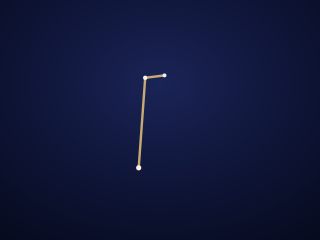 Equuleus
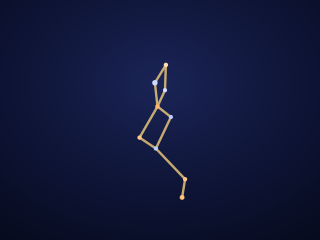 Lacerta
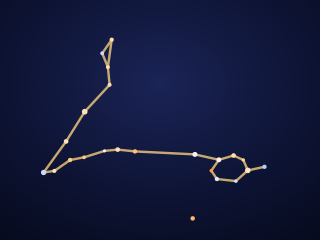 Pisces
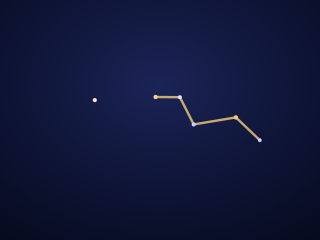 Vulpecula